
Levelling the playing field: how smart lockers fix courier earnings inequality and open the trade to more female riders
A 24th-floor drop earns the same as a doorstep drop, but takes ten times as long — punishing couriers in dense urban buildings. And the safety friction of going inside strangers' buildings keeps female ridership in the UK below 5%. Smart lockers fix both at the same time.
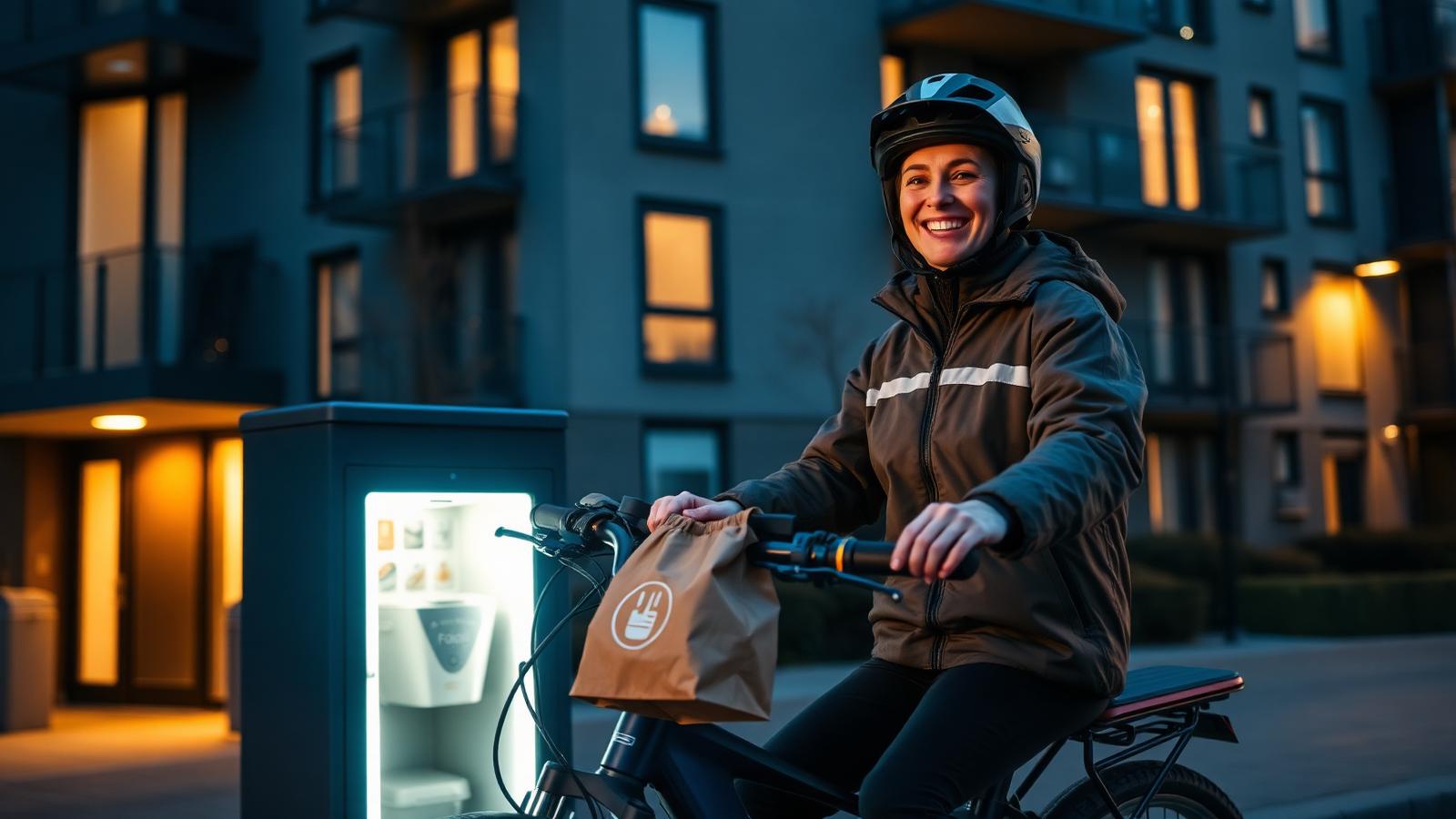
There's a quiet inequality baked into the way the UK delivery economy currently works, and it shows up most clearly in two places: how much a courier earns per hour depending on which building they're sent to, and how few of those couriers are women. Both are downstream consequences of the same root problem — the handover model. The locker conversation is usually framed around residents, operators and platforms. It's worth flipping the camera around and looking at it from the saddle, because the courier-side case for lockers is arguably the strongest one in the entire stack.
Two things follow from a building handing off in 60 seconds at a locker instead of 6–10 minutes at a 24th-floor flat. The first is that couriers in dense urban areas finally earn at the same rate as couriers in suburban ones. The second is that the trade becomes materially safer to enter — and the demographic that has been most explicitly excluded by safety friction, female riders, can actually choose it as a job.
The hidden geography of courier earnings
Couriers on Deliveroo, Uber Eats and Just Eat are paid per delivery, not per hour. That single design choice means the time it takes to complete a drop is the most important variable in their pay packet. And drop time is heavily, almost brutally, dependent on the building.
- Suburban semi-detached: cycle to the front gate, hand over, ride on. 60–90 seconds at the address.
- Mid-rise flat with a working entry phone: buzz, wait, lift, knock, hand over. 4–6 minutes.
- High-rise tower, 20th-plus floor: buzz, wait, lift queue, corridor walk, knock, wait, lift back down. 8–12 minutes.
- Multi-core campus with one postcode: add 3–5 minutes of wayfinding before the building drop even starts.
That difference compounds across a shift. A courier doing five suburban drops an hour earns broadly five fees. A courier sent to the same number of high-rise jobs in the same hour earns one or two — even though the gross 'demand' served looks identical from the platform side. Over a week, that's the difference between a viable wage and not.
Why this is also unfair to the platform and the building
The inequality isn't only the courier's problem. Platforms see longer drop times as 'inefficient supply' — which over time means urban couriers quietly drift to suburban shifts, or out of the trade altogether. That contracts the supply pool exactly where consumer demand is highest. Restaurants in dense central postcodes see slower assignment times. Residents see longer ETAs. Buildings see more cancellations. The friction shows up everywhere, but the cost is initially absorbed entirely by the courier.
It's also unfair geographically. A courier working a wealthy central-London postcode of 30-storey towers earns less per hour than one working a postcode of three-bed semis fifteen miles out, despite the central courier doing arguably the harder job in worse conditions. There is no defensible reason for that to be true. It's an artefact of the handover model, not the delivery economy itself.
What a 60-second locker drop actually does to courier earnings
Replace the door-to-door drop in a tower with a locker handover at the building entrance, and the per-drop time collapses to roughly the same as a suburban handover. The geography stops mattering. Concretely, on a typical evening shift in a dense postcode:
- Door-to-door tower drop: ~10 minutes per delivery — 5–6 deliveries per hour at peak
- Locker drop at the same building: ~60 seconds at the locker — 9–11 deliveries per hour at peak
- Earnings uplift on a busy night: typically £25–£40 per shift, sometimes more
- Bike never leaves line of sight, so theft exposure also collapses
That isn't a marginal improvement. It's the difference between an urban delivery shift being economically rational and not. And it doesn't require any change to platform pricing — the platform doesn't have to pay couriers more, the building just has to stop slowing them down.
For the wider operator-side framing, see Door or lobby? The food delivery debate.
The female-rider gap is a safety gap, not a preference gap
Women make up an estimated 1–4% of food-delivery couriers in the UK, depending on the platform and city. The numbers in some other European markets are slightly higher; in others, lower. Either way, the disparity is enormous and has been remarkably stable for years.
Industry research, rider testimony and union surveys all converge on the same explanation: it isn't a preference gap, it's a safety gap. The job, as currently structured, requires couriers to:
- Ride alone late at night, often in poorly-lit residential streets
- Enter the lobbies, lifts and corridors of strangers' homes — repeatedly, for short unsupervised intervals
- Wait at front doors, alone, while strangers locate cash, change orders or argue about delivery
- Leave their bike — their main earning asset — unattended on the pavement during every drop
- Manage harassment incidents with no on-shift colleague within sight or earshot
Each of those frictions is a barrier to entering the trade in the first place — and a reason many female riders who try it leave within months. The platforms have, to their credit, added in-app safety features, but the structural element of being inside strangers' buildings late at night is something only the building can fix.
Lockers as the structural fix
A locker handover at the building entrance changes almost every line on that list. The courier doesn't enter the lobby, the lift, the corridor or the floor. The drop happens in plain sight of the street and CCTV. The bike stays within view. The interaction with the resident is mediated by software — there is no door-stoop conversation. The courier rides on inside a minute.
That's not a small thing. It removes most of the safety friction that has, for years, kept the trade overwhelmingly male. It doesn't single-handedly fix the gender ratio — pay, harassment laws, lighting, public realm and platform policy all matter — but it removes one of the largest structural barriers, and the one most directly within the building's control.
There's also a downstream effect worth naming. A more diverse courier workforce is, by every available indicator, a safer and more accountable courier workforce — for residents and for other riders. The female-rider gap and the resident-safety conversation aren't separate stories; they're two sides of the same handover problem.
What the building can do, today
If a building wants to be on the right side of this — both economically for the couriers it depends on, and culturally for the workforce it admits — there's a small set of moves that materially shift it:
- Install a locker bank in the entrance core so no courier has to go above the ground floor
- Register the locker as the official drop point with Deliveroo, Uber Eats, Just Eat and the major grocery platforms
- Light the locker zone properly and put it in clear CCTV coverage
- Provide a covered area where couriers can stand and rest for a moment between drops without being moved on
- Publish a one-line policy: 'couriers drop at the locker — no need to enter the building'
None of those are expensive. Together they convert the building from one that quietly takes earnings out of every courier's pocket into one that pays them back time, and removes the largest single structural barrier to women entering the trade.
For the wider safety case, see Why locking food couriers out of buildings makes everyone less safe and the Building Safety solution overview.
Why this matters for the long-term economics of delivery
Delivery in the UK is now a category that residents, restaurants, supermarkets and meal-kit subscriptions all depend on. That whole stack is propped up by a courier workforce that is currently being underpaid in dense urban buildings and structurally excluding half the population. Neither is sustainable. The buildings that fix the handover model first won't just have happier residents — they'll have first call on the courier supply when the trade starts to normalise.