
Smart food lockers and the Building Safety Act 2022: a guide for Accountable Persons
The Building Safety Act 2022 made the Accountable Person responsible for managing risks in the common parts of higher-risk buildings. Here's why uncontrolled courier access is now a Building Safety problem — and how smart lockers solve it.
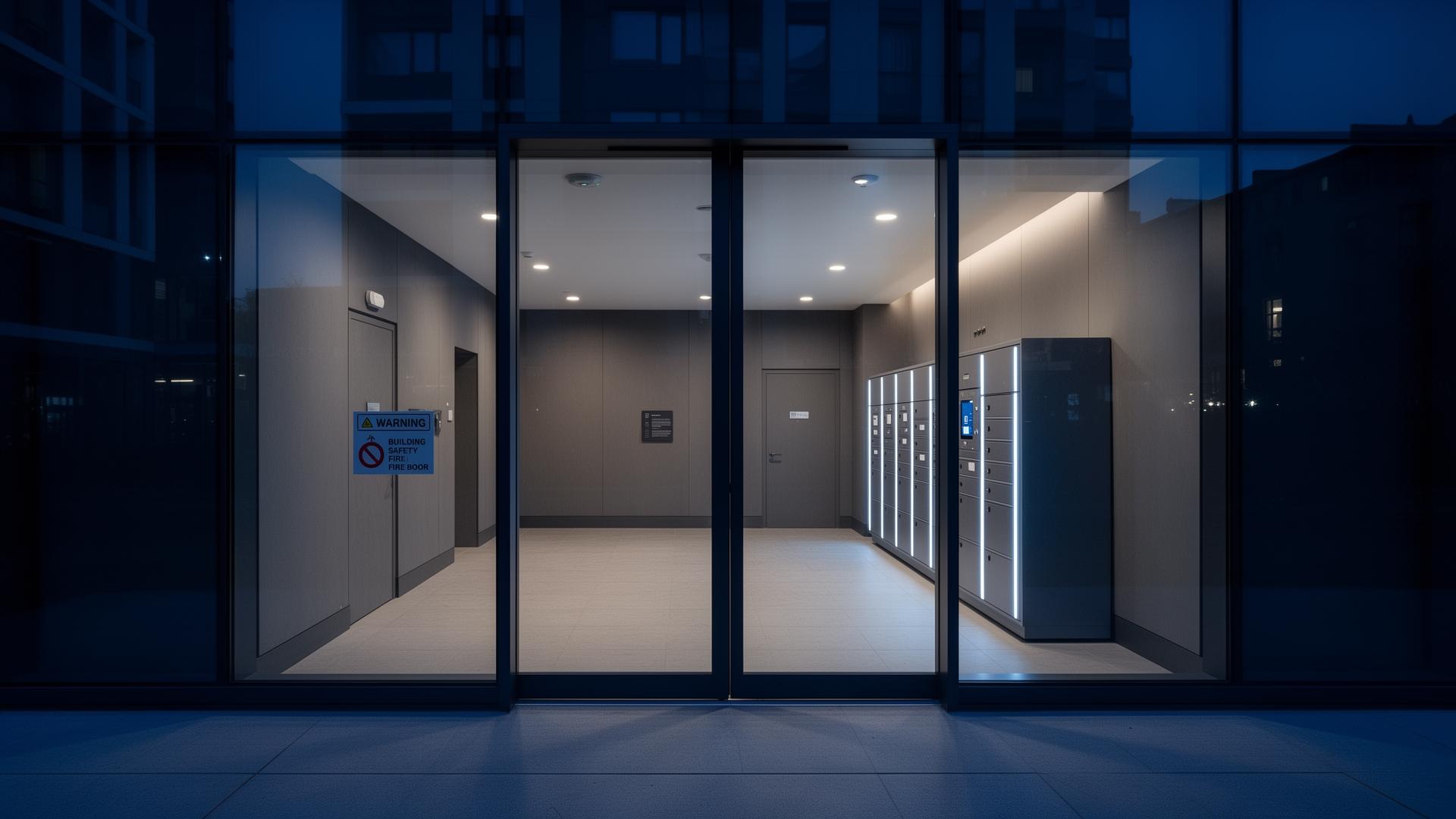
The Building Safety Act 2022 made the Accountable Person legally responsible for managing risks in the common parts of higher-risk residential buildings. The Act doesn't list specific controls — it sets an outcome: identify the building safety risks, manage them proportionately, and be able to evidence what you did and why.
Food and parcel couriers are now the highest-frequency uncontrolled access route into UK apartment blocks. Every delivery is a stranger buzzing flats, being let through by anyone who answers, and walking past fire doors that get propped open at peak meal times. For an Accountable Person, that's no longer just a resident-experience issue — it's a building safety risk in the common parts that needs an answer.
What the Building Safety Act actually requires
The BSA 2022 introduced a new regulatory regime for higher-risk buildings (HRBs) — generally residential buildings of at least 18 metres or seven storeys with two or more dwellings. The Act creates the role of the Accountable Person (AP), who is responsible for the structural and fire safety of the building, including the common parts.
Key duties under the Act include assessing and managing building safety risks on an ongoing basis, maintaining a 'golden thread' of building information, producing a Safety Case Report, and engaging residents on safety matters. The Building Safety Regulator (BSR), within the HSE, oversees compliance.
Critically, the duty isn't tied to a fixed checklist — APs must demonstrate they have considered and proportionately mitigated reasonably foreseeable risks in the common parts. Uncontrolled, high-frequency third-party access is one of those risks.
Why courier access is now a Building Safety risk
A typical 200-unit BTR or PBSA building now receives 400–600 food and parcel deliveries a week, concentrated at peak hours. Each one is an unvetted person attempting access to the common parts:
- Couriers buzz multiple flats until someone lets them through — bypassing the building's access control
- Lobby and fire doors get propped open during peak waves of deliveries
- Riders walk corridors and lift cores looking for flat numbers, often unsupervised
- Bags are left on lobby counters, outside flat doors, or in stairwells — all common-part areas the AP is responsible for
- There is no audit trail of who entered, when, or what they were carrying
Each of these is, on its own, a manageable nuisance. Together, they are a sustained, repeating uncontrolled access pattern in the common parts of a higher-risk building. That's exactly the category of risk the Accountable Person is required to consider.
The lone-resident dimension
There's a second risk that often goes unmeasured: lone residents — students, women living alone, shift workers, older or vulnerable people — opening their flat doors to anonymous couriers late at night. The building's access control protects the front door but not the flat door, and the resident has no way to verify the person on the other side.
This isn't a hypothetical. UK police forces have repeatedly flagged courier impersonation and tailgating as a vector for residential burglary and harassment. From a duty-of-care perspective — and increasingly from an insurance perspective — operators are expected to design this risk down where they reasonably can.
How smart lockers operate as a Building Safety control
A smart food and parcel locker bank, sited in the entrance zone, replaces uncontrolled courier access with a controlled, audited handover. The courier never enters the common parts beyond the entrance. The resident never opens their flat door to a stranger. And the AP gets a complete, exportable record of every event.
- Couriers complete the handover at the locker — they don't pass through the lobby into corridors or lift cores
- Fire and lobby doors stop being propped because the door doesn't need to keep opening
- Per-courier credentials and one-time resident PINs prevent shared codes and tail-gating
- Every drop and collection writes to an immutable log with timestamp, compartment ID and credential
- Logs export in seconds for incident review, insurance, BSA evidence or police requests
This is the kind of proportionate, evidenced control APs are expected to put in place: it addresses a foreseeable risk, it does so without creating new ones (couriers loitering on the pavement, residents collecting outside late at night), and it produces the audit data the regulator increasingly expects.
What good evidence looks like
If the BSR or an insurer asks how the AP is managing courier access in the common parts, a documented locker-based regime answers cleanly:
- Standing instruction at the building's delivery address: drop at locker, do not buzz flats
- Locker bank sited within the access-controlled entrance zone, not on a resident floor
- Per-event audit log retained for an agreed period
- Resident communications explaining the policy and how to collect safely
- Periodic review of locker utilisation and any out-of-policy events
That package — a control, a procedure, an audit trail and an engagement record — is materially stronger than 'the concierge tells couriers off when they prop the door'.
Where this fits in the broader Building Safety picture
Smart lockers are not a substitute for fire-safety engineering, structural assessments or the Safety Case. They sit alongside those things as one of the more cost-effective, high-frequency operational controls an AP can deploy in the common parts. They're particularly relevant for BTR, PBSA, co-living and hotel-residential schemes where delivery volumes are high and the population includes a meaningful share of lone residents.
Foodie Locker is built specifically for this use case — heated, ambient and chilled compartments for food, separate parcel banks where required, full audit logging, integration with access control and PMS, and standing-instruction handover flows that make 'drop at locker' the default for every courier.
Related reading: Building Safety solution overview · An accident waiting to happen · Designated drop zones for multi-tenant campuses.