
Designated drop zones: how to fix food delivery on multi-tenant campuses
One postcode, eight building cores, and a courier on the wrong doorstep. Here's how designated drop zones, geocoded locker addresses and standing platform instructions end the wayfinding chaos on BTR, PBSA and mixed-use campuses.
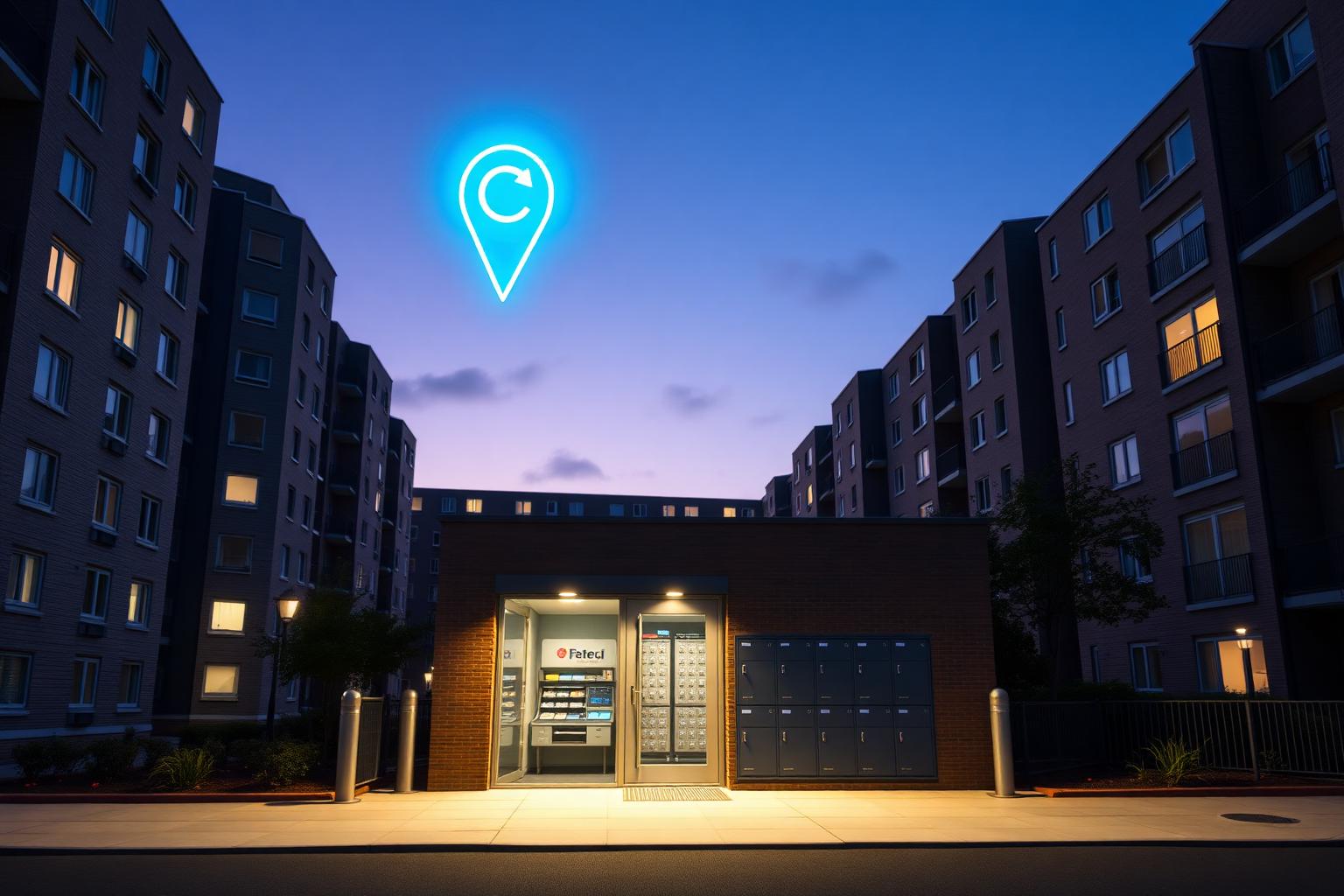
A six-core BTR scheme with 800 flats has one postcode and eight front doors. A student campus has ten blocks behind a single security gate. A mixed-use estate has retail at street level and residents on floors 4–18 with a separate entrance round the back. None of that information makes it into the courier app. The pin drops on the postcode, the courier follows it, and three minutes later they're buzzing the wrong block trying to find the right resident.
This is the wayfinding problem — and it's quietly the single biggest reason food deliveries to multi-tenant buildings go wrong. Designated drop zones fix it at the building, the locker and the platform layer simultaneously. Here's how.
Why one postcode breaks every food delivery app
UK postcodes were designed for the Royal Mail in the 1950s — a single postcode covers anything from a single building to a whole street of 200 flats. Every major food-delivery platform — Deliveroo, Uber Eats, Just Eat — uses that postcode as the primary geocode. So on any campus where one postcode covers multiple cores, every order routes the courier to the same pin. From there, the courier guesses.
On a small site this is annoying. On a 6-core BTR scheme or a 10-block PBSA campus it's chaos. Couriers ring every flat trying to find the resident. Concierge teams spend hours a week giving directions over the intercom. Food goes cold. Refunds get raised. Residents blame the building.
What a designated drop zone actually is
A designated drop zone is a single, registered, geocoded handover point per building core or entrance — not per postcode. Each drop zone has:
- A precise lat/long and what3words address
- A photo of the entrance and walking route
- Standing courier instructions registered with each delivery platform
- A specific locker bank that owns it
So instead of 'the postcode' the courier app shows 'the door beside the locker bank, third entrance from the south, three-word address /// table.lamp.book'. They go straight there. The compartment opens. The handover is done in under a minute.
The four-layer fix
Foodie Locker treats drop zones as a productised wayfinding stack, not a one-off building setup. The four layers:
- Per-locker geocoding: every locker bank gets its own lat/long, what3words address and shortcode, baked into our system
- Standing platform instructions: we register each drop zone with the building's profile on Deliveroo, Uber Eats and Just Eat — including address line 2, courier notes, photo and access information
- Flat-to-bank routing: the resident's flat number maps to the correct locker bank automatically — no resident input required at checkout
- Arrival confirmation: the compartment only opens once the courier confirms arrival at the correct bank, via QR scan, PIN or geofence check
Each layer alone helps. Together they make a 6-core campus feel, to the courier, like eight individual buildings — each with its own clean drop point — while still appearing to the resident as one address.
Why what3words matters here
what3words divides the world into 3-metre squares, each with a unique three-word address. UK emergency services, AA recovery and most major delivery platforms now accept what3words as a routing input. For multi-tenant buildings it's transformative — every entrance can have its own three-word address pointing at exactly the right pavement square, regardless of postcode overlap.
Foodie Locker registers a what3words address for every locker bank on day one of installation, and embeds it in the standing courier instructions on every platform. From the courier's perspective, it's the difference between 'somewhere on this estate' and 'this exact paving slab'.
The operator outcomes
- Couriers find the right entrance first time — buzzer-roulette ends
- Concierge time spent giving directions drops sharply (operators we've spoken to estimate 80–90%)
- Wrong-bank drops are caught before food is left, so refund disputes fall
- Couriers stop using fire escapes and propped service doors as shortcuts — they don't need them
- Residents stop blaming the building for slow deliveries — because deliveries stop being slow
Drop zones and Building Safety: the same fix
There's a useful overlap with the Building Safety Act 2022 story. Couriers wandering a campus looking for the right door is also one of the main reasons fire and lobby doors get propped, riders end up on resident floors and unbadged strangers reach lift cores. A registered drop zone with a locker handover removes the wandering, removes the door-propping and removes the need for couriers to enter at all.
In other words, designated drop zones aren't only an operational story — they're a Building Safety control with a hospitality wrapper.
Read the full BSA write-up: Smart food lockers and the Building Safety Act 2022.
What to do this quarter
If you operate a multi-core or multi-entrance scheme, the highest-leverage move you can make in the next 90 days isn't more concierge — it's mapping every flat to a designated drop zone and registering each zone with the platforms. Foodie Locker does both as part of every install, and we'll retrofit it for buildings that already have lockers from another vendor.
See the full Designated Drop Zone solution: /solutions/delivery-wayfinding.