
An accident waiting to happen: unvetted couriers in residential buildings
Tens of thousands of unvetted, unaccompanied food and parcel couriers walk into UK apartment buildings every night. No background checks, no escort, no record. The next serious incident isn't a question of if — it's when. Here's what operators can do before it lands on their watch.
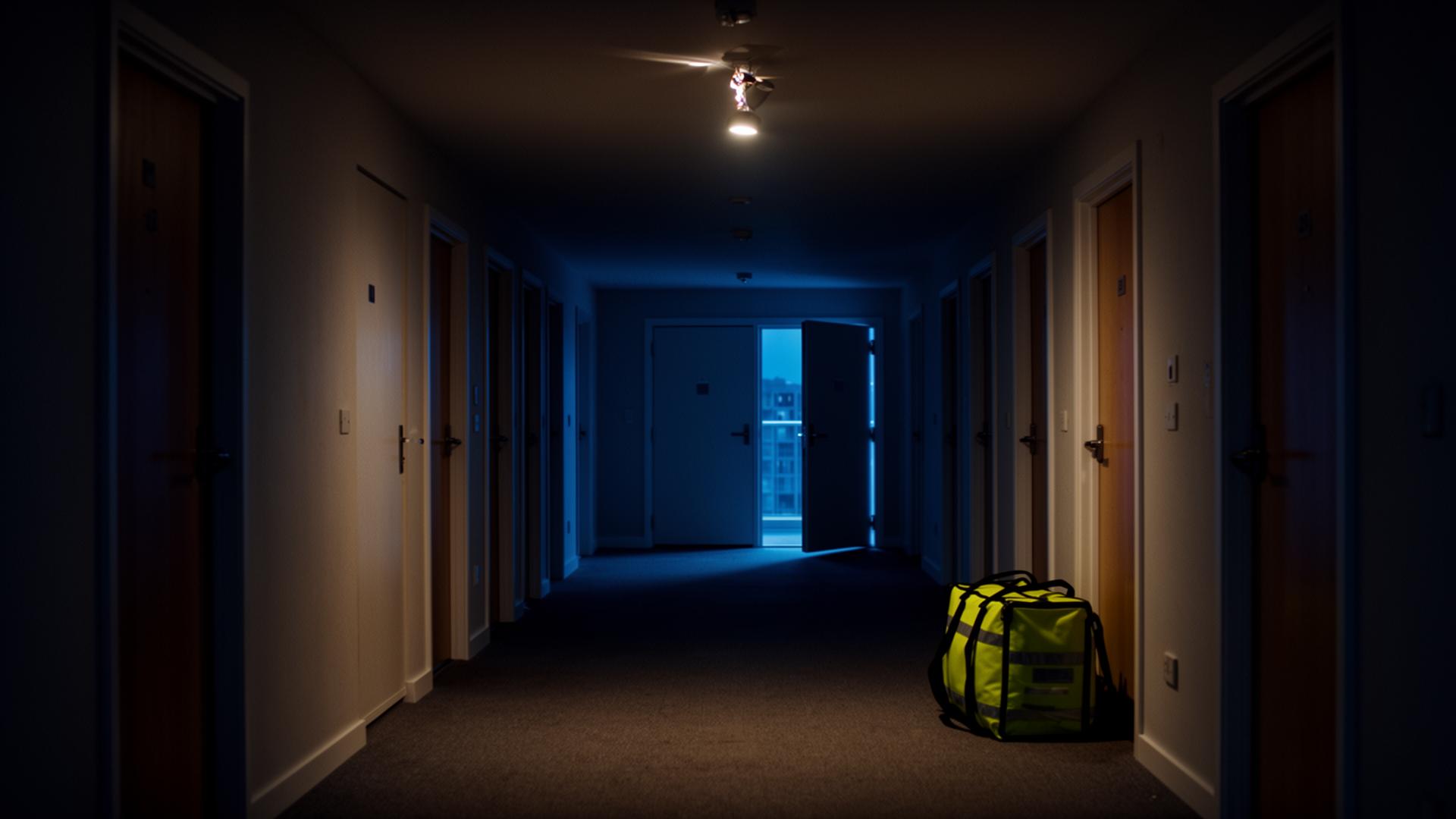
Tonight, in residential buildings across the UK, tens of thousands of unvetted, unaccompanied strangers will walk past locked front doors, into communal corridors, up to people's flats. They'll buzz buttons until someone lets them in. They'll prop fire doors open. They'll knock on doors at 11pm. Some will be tired, some will be lost, some will be in a rush. Almost all of them will be food and parcel couriers — and almost all of them are perfectly fine.
But the system that lets them in isn't fine. It's an accident waiting to happen. And when it happens, the question isn't going to be 'who was the courier?' — it's going to be 'who let them in, and what controls did the building have in place?'
What we've quietly normalised
Walk into almost any UK apartment block at 7pm on a Friday. Someone in hi-vis is standing at the door with a stack of insulated bags, pressing buzzers in sequence until a voice says 'come up'. They're inside in seconds. No name verified, no ID checked, no escort, no record of who admitted them. Two minutes later they're outside a flat — a flat where, often, someone is alone.
Repeat that 400 times a week per building. Multiply by every BTR, PBSA, co-living and managed apartment scheme in the country. The aggregate is a sustained, daily, repeating uncontrolled access pattern that no other industry would tolerate. Imagine a hospital, school or office accepting an equivalent volume of unbadged strangers walking unaccompanied through restricted areas — it would be a national scandal within a week.
Most couriers are fine. The exposure isn't.
This isn't an attack on couriers. The vast majority are doing a hard, low-paid, weather-exposed job and want to get in and out as fast as possible. The point isn't that any individual courier is a threat. The point is that the building has no way to know — and no record afterwards.
UK police forces have repeatedly flagged courier impersonation as a vector for residential burglary. Hi-vis, an insulated bag and a confident manner are an effective way to bypass building access control. Operators don't need to assume bad faith to take this seriously; they just need to acknowledge that 'we let anyone in a hi-vis through' is not a control.
The five incidents that are already happening
Talk to any large BTR or PBSA operator and you'll hear the same shortlist of incidents — most never reported externally, most quietly absorbed by the front-of-house team:
- Lone-resident harassment: a courier knocks, the resident opens, an exchange escalates
- Burglary by impersonation: someone in hi-vis is admitted, walks the building, returns later
- Theft of unattended bags from lobby counters and outside flat doors
- Assault and intimidation between couriers and concierge over disputed handovers
- Fire-door and lobby-door propping during peak hours, defeating compartmentation
None of these are hypothetical. All of them are recurring. And all of them sit, legally, on the building operator and the Accountable Person — not on Deliveroo, Uber Eats or the courier.
Why the next serious incident is a 'when'
Three trends are making this worse, not better. First, food-delivery volume per resident is still rising — every new building opens with higher baseline order volumes than the one before. Second, residents are getting younger, more single-occupancy, and ordering later at night. Third, courier turnover is high and platforms have no contractual access to give buildings any meaningful identity assurance about who's at the door.
So the exposure compounds. More deliveries, more lone residents, less identity continuity. The probability of a serious incident in any one building on any one night stays small. The probability across a national portfolio over a year does not.
What 'we banned them' gets wrong
Some operators have responded by banning couriers from entering at all. It feels decisive. It is also worse. The riders end up loitering in groups on the pavement; residents — including the lone, late-night, vulnerable residents the policy was supposedly protecting — have to come outside alone to collect. The original risk doesn't go away; it gets relocated to the street, where the building has even less control.
The honest answer isn't 'keep them out' or 'wave them in'. It's 'change where the handover happens'.
What good actually looks like
A controlled handover layer at the building entrance turns the problem from 'unvetted strangers in corridors' into 'a logged, contactless drop in the lobby'. Couriers complete the delivery without entering the common parts. Residents collect on their own schedule, contactlessly, without opening their front door to anyone. Every event is timestamped and exportable.
- No flat-door knocks at midnight from a stranger the resident can't verify
- No buzzer-roulette to be admitted to the building
- No fire doors propped — the doors don't need to keep opening
- No unattended bags on lobby counters or outside doors
- A defensible audit trail if anything ever does go wrong
This is what operators actually wanted from the original ban — couriers off resident floors, no unattended bags, no lobby chaos — without offloading the problem onto the pavement, the courier or the resident.
Don't wait for the headline
The cost of fixing this is small and known. The cost of not fixing it is unbounded — a single serious incident attached to an operator's name will travel further than a hundred good resident reviews. Insurers are starting to ask the question. The Building Safety Regulator will, eventually, ask the question. The first national news story about a courier-related serious incident in a managed residential building will ask the question very loudly.
The buildings that put a controlled handover layer in now will be the ones that can answer it. Foodie Locker exists for exactly that reason: to make 'we know who came in, when, and what they did' the new baseline — before it has to be.
Related reading: Building Safety solution overview · Building Safety Act 2022 — guide for Accountable Persons · Designated Drop Zone solution.