
Safeguarding and food delivery on university campuses: protecting students and couriers
Delivery issues in university halls are a safeguarding issue — for students and for the couriers who serve them. Research found 81% of Scottish food delivery couriers feel unsafe at work. Here's how universities build a safer campus delivery model.
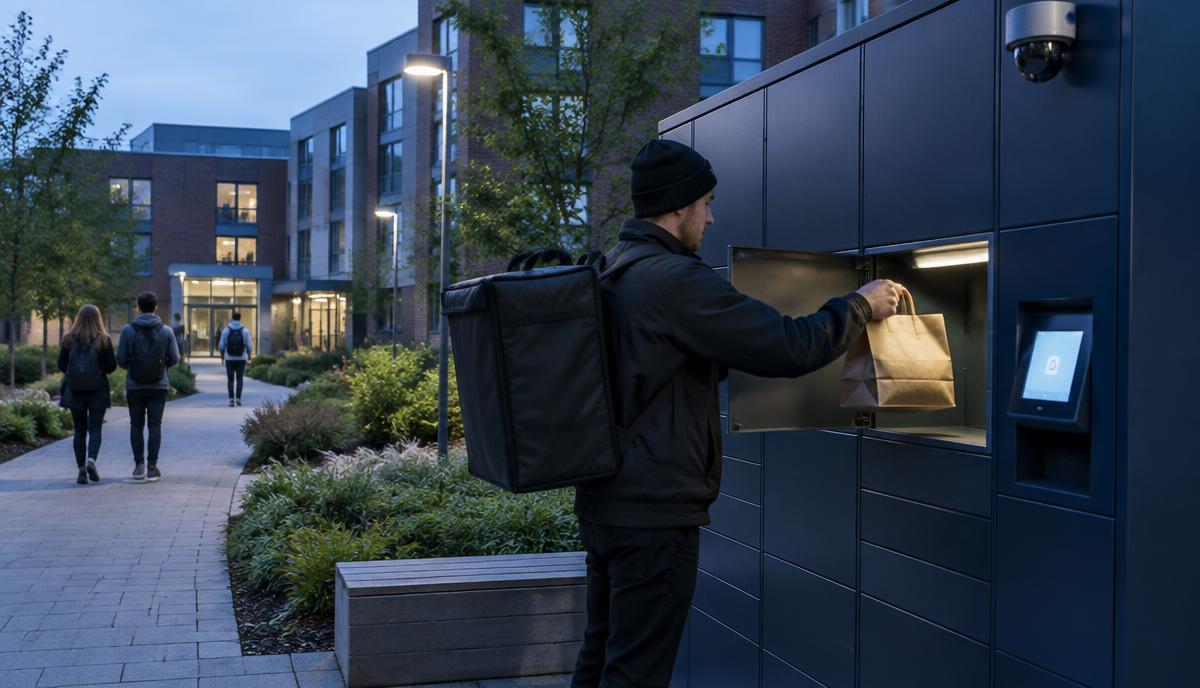
Ask most universities about food delivery and you'll hear an operational answer: couriers can't get in, reception won't accept food, drivers wander the estate, meals go cold. But look closer and it's a safeguarding issue — with two groups of people at risk, not one.
On one side are students: strangers tailgating into halls, late-night handovers in car parks and unlit courtyards, vulnerable students left without food when a delivery fails. On the other are the couriers themselves, who a major UK study found are working in conditions most universities would never accept for their own staff.
This guide sets out the safeguarding case for designing campus food delivery properly — and what a safer model actually looks like.
What the research says about courier safety
A two-year study of 207 food delivery workers across Scottish cities — led by Dr Pedro Mendonça at Heriot-Watt University's Centre for Employment, Work and the Professions, with Dr Anastasios Hadjisolomou (University of Strathclyde) and Dr Nadia Kougiannou (Nottingham Trent University) — found conditions that should give any institution pause:
- More than 81% felt unsafe in their job, but continued out of financial necessity
- Every one of the 33 women surveyed had experienced sexual harassment or abuse
- Over 60% had suffered racial or ethnic abuse
- 55% had been physically abused, primarily linked to road incidents and accidents
- 78% believed their employer prioritised customers over workers
- Delivery work was the primary income for 48% of those surveyed, many of them migrant workers with few alternatives
Source: Fair Gig Work in Scotland? A Review of Employment Practices in the Scottish Food Delivery Work (Mendonça, Hadjisolomou & Kougiannou, May 2024) — reported by Heriot-Watt University and the University of Strathclyde.
Universities are among the biggest single generators of food delivery journeys in any UK city. A campus of several thousand students can pull hundreds of courier trips a day onto its estate. If the handover point is a dark car park, a locked side door or a confusing block address, the institution is contributing directly to the risk profile those studies describe.
Why this is a safeguarding issue for students too
Ad-hoc delivery arrangements create a predictable set of student safeguarding risks:
- Tailgating and door propping — an unverified stranger inside a residential building, often at night
- Late-night lone handovers — students meeting couriers outside, in poorly lit or unmonitored areas
- Personal data exposure — room numbers, phone numbers and full names shared with platforms and drivers
- Welfare gaps — vulnerable, unwell or self-isolating students left without food when a delivery fails
- Unattended food — meals left in lobbies or on doorsteps, creating theft, tampering and food-safety risks
- No audit trail — when something goes wrong, no record of who entered, when, or what happened
Most universities already publish delivery rules that push the problem outside: couriers may only reach the front door, reception cannot accept food, students must meet the driver themselves. Those policies protect the building, but they move the risk onto the student and the courier standing in the dark.
The policy gap: no framework for third-party delivery drivers
Universities have mature safeguarding frameworks for staff, students, contractors and visitors. Third-party gig couriers usually sit outside all of them. They are not employees, not contractors and not registered visitors — yet they arrive on the estate hundreds of times a day, often after dark, frequently interacting with young residents.
That gap is why so many institutions end up improvising: a security guard stationed at a collection point, a what3words pin shared on the accommodation intranet, a rule that drivers must call from the gate. These are sensible responses to a real problem — they're just manual, staff-intensive and impossible to audit.
What a safer campus delivery model looks like
The safeguarding answer is to remove the unmanaged human handover entirely and replace it with a designated, monitored, automated collection point.
- One verified destination per building or hub — a geocoded address couriers can find first time, no roaming the estate
- Handover at the perimeter — couriers never need to enter residential buildings, so tailgating and door propping stop being possible
- Lit, CCTV-covered, busy locations — collection points sited on primary routes so the places students walk to at night are the most active on campus
- PIN or QR release with full audit trail — every drop-off and collection time-stamped and attributable
- Insulated compartments — food stays in acceptable condition during short dwell times, removing the pressure for instant, risky handovers
- 24/7 self-service collection — students collect when it's safe and convenient for them, not when a driver is waiting outside
- Minimal data exposure — couriers get a locker code, not a room number
The courier benefit is just as concrete: a short, predictable, well-lit stop; no waiting alone; no confrontation over a failed delivery; no chasing a student around an estate while the clock runs. Shorter dwell time also means less exposure to the road and traffic risks that the Scottish study identified as a leading source of physical harm.
Writing it into your safeguarding and estates policy
If you're formalising this, the following clauses carry the most weight with safeguarding leads, estates directors and residential services teams:
- Designated collection points are the only authorised food and grocery delivery destination on the estate
- Third-party couriers are not permitted beyond the designated point in any residential building
- Collection points must be lit, CCTV-covered and sited on a monitored primary route
- All drop-offs and collections must generate a retained, auditable record
- Students must never be required to meet a courier in an unlit or unmonitored area
- Welfare exceptions — a named process for isolating, disabled or vulnerable students who cannot reach the hub
- Annual review against incident data, security call-outs and student feedback
Measuring whether it's working
Safeguarding improvements should be evidenced, not asserted. The metrics estates and security teams can actually track:
- Unauthorised access and tailgating incidents in residential buildings
- Security and reception interventions relating to deliveries
- Courier dwell time and vehicle movements on the estate
- Failed or disputed deliveries
- Late-night incident reports at known handover locations
- Student survey responses on feeling safe after dark
For the cost side of the same argument see our guide to reducing campus security guard costs, and for the estate-design side, campus wayfinding and student experience.
To see how this works across a live estate, explore our student campus solution or book a walkthrough.