Safer food deliveries: how designated delivery hubs can protect riders and make campus deliveries more efficient
Discover how designated food delivery points and smart lockers can improve rider safety, reduce delivery time and create safer food delivery environments across universities, student accommodation and residential developments.
Food delivery has transformed how people live in university accommodation, student housing and large residential developments. But the physical infrastructure around delivery hasn't always kept pace.
A rider may successfully navigate several miles across a city only to arrive at a university campus or large residential estate containing multiple buildings, entrances, gates and hundreds — or even thousands — of residents. The final few hundred metres can involve searching for the correct entrance, calling the customer, waiting outside, navigating unfamiliar or poorly lit areas and sometimes entering residential buildings to locate the recipient.
That creates inconvenience for residents and building teams. But there is another side of the issue that receives far less attention: the safety and working environment of the delivery rider.
Delivery rider safety is a genuine issue
Food delivery riders work alone, frequently after dark and often in unfamiliar locations.
Deliveroo has publicly called for greater protection for delivery workers, reporting increases in abusive incidents involving riders, including verbal abuse, racism, sexism, threats, assault and theft. Deliveroo's own rider guidance also makes clear that riders do not have to complete an order where they feel unable to do so because of concerns for their safety.
Research published by the University of Cambridge provides a wider picture of working conditions in the UK gig economy. In the study, 51% of surveyed delivery and driver gig workers said they risk health and safety while working, while three-quarters reported anxiety about their income falling.
These issues can be particularly relevant during evening and late-night deliveries — the same periods when food-delivery demand can be high across student accommodation and residential developments.
The question for universities, PBSA operators and residential estate managers should therefore not only be: “How do we keep residents safe when food is delivered?” It can also be: “How do we create a safer, simpler and more efficient environment for the people delivering it?”
A better model: the designated food delivery point
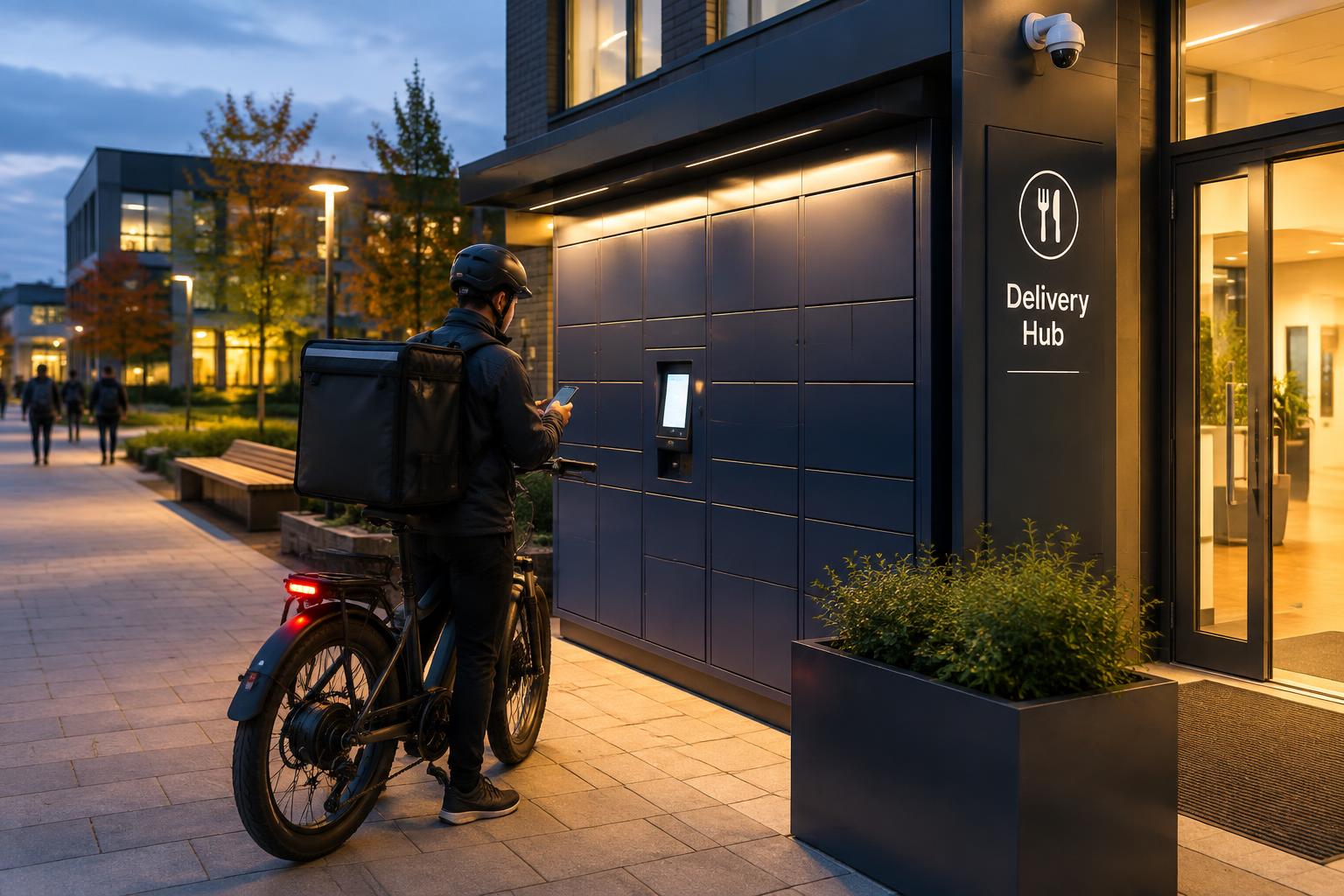
Imagine arriving at a university campus at 11pm to make a delivery. Instead of navigating multiple blocks, looking for an entrance, calling the student and waiting somewhere unfamiliar, the rider is directed immediately to a clearly marked, well-lit delivery hub, covered by CCTV and accessible directly from the main delivery route.
The rider arrives, identifies the order, deposits it securely into the designated locker and continues to their next delivery. The student receives a notification and collects the order separately.
No searching the campus. No entering accommodation. No waiting for the customer. No unnecessary journey through unfamiliar residential areas. That's the infrastructure model Foodie Locker is designed to enable.
Designing safer delivery zones
A smart locker alone isn't the entire answer. The location of the delivery point matters. Foodie Locker can help universities and residential operators create a designated delivery zone positioned around the needs of residents, site teams and delivery riders. Where possible, that means considering:
- a well-lit and highly visible location
- CCTV coverage
- proximity to the main vehicle/cycle delivery route
- separation from private residential areas
- clear signage
- precise digital wayfinding
- easy access without navigating multiple security doors
- a short drop-off process
- 24/7 accessibility where appropriate
Foodie Locker's delivery-wayfinding technology can give locker banks their own geocoded drop point, including what3words location, entrance imagery and standing delivery instructions. For a large university or residential development, that changes the final stage of the delivery journey.
Instead of: postcode → security gate → wrong building → phone call → another entrance → wait for resident — the journey becomes: postcode → designated Foodie Locker delivery hub → secure drop-off → next order.
Supporting female delivery riders
There is an important gender dimension to this conversation too. Female couriers can work alone at night and may be required to travel into unfamiliar locations to complete deliveries. More broadly, the delivery sector has documented concerns around harassment and personal safety affecting people on both sides of the delivery interaction.
Foodie Locker doesn't claim that technology can eliminate those risks. But the physical environment in which the handover happens can be designed better. A clearly designated, illuminated and CCTV-covered collection point can reduce the need for a rider to navigate secluded areas of an estate, enter residential corridors or wait alone while trying to contact a customer.
For universities in particular, this creates an opportunity to consider delivery riders within the wider campus safety strategy. Safe delivery infrastructure should work both ways: residents should not need unknown couriers entering their accommodation — and riders should not need to enter unfamiliar residential environments simply to complete a delivery.
Could designated drop-off points also help riders earn more?
Safety isn't the only potential benefit. Time matters to delivery riders. The Cambridge research found surveyed gig drivers and riders reported spending an average of around 10 hours per week waiting for jobs while logged into their apps but not earning from a job. Foodie Locker cannot determine rider pay, platform allocation or earnings. But there is a straightforward operational principle: less time searching and waiting can mean more time available for deliveries.
Consider a 2,000-bed university campus. A rider arrives carrying an order and then has to: find the correct hall → find the entrance → call the student → wait for them to come downstairs → complete the handover → navigate back out. Now replace that with a recognised delivery hub positioned near the campus entrance: arrive → deposit → confirm → leave.
If the same rider has multiple orders for the same large development, the potential becomes even more interesting. One campus. Multiple orders. One destination. Traditionally, three orders for Hall 1, Hall 4 and Hall 7 could mean three separate customer handovers. With a central Foodie Locker hub:
- Order A → Locker 32
- Order B → Locker 47
- Order C → Locker 61
Three deliveries. One stop. The platform still controls how jobs are allocated and how riders are paid, so Foodie Locker does not claim a guaranteed increase in rider earnings. But reducing the time required at the destination has the potential to improve delivery productivity — particularly across high-density environments such as university campuses, PBSA developments and large BTR estates. And that's a conversation Foodie Locker believes is worth having with delivery platforms.
The university campus is an ideal use case
Universities can be particularly challenging delivery environments. One postcode can represent multiple halls, hundreds of rooms and numerous entrances spread across a large estate. Foodie Locker already addresses this through its designated drop-zone and delivery-wayfinding proposition: each locker bank can have a precise geocoded location, what3words address, entrance image and delivery instructions.
Combine that with strategically positioned locker hubs and a university could establish something much simpler — the Campus Food Delivery Hub: a recognised destination for takeaway orders, grocery deliveries, prepared meals, meal kits, food subscription boxes and campus catering collections. For larger campuses, several hubs could create a campus-wide food delivery network, with riders directed to the closest appropriate hub rather than individual accommodation blocks.
For the resident-side case for this model, see our food delivery lockers for PBSA and student accommodation, our delivery wayfinding solution and our guide to safeguarding and food delivery on university campuses.
Better for riders. Better for residents. Better for operators.
The most interesting aspect of designated food delivery infrastructure is that the interests of all three groups can align.
- For delivery riders — clearer wayfinding, less searching, less waiting, fewer journeys through unfamiliar residential areas and a designated location designed with safety in mind
- For residents — not having to wait outside for a rider, disclose unnecessary residential access or allow unknown visitors into accommodation areas
- For universities and residential operators — fewer couriers circulating around the estate, reduced pressure on reception and security teams, clearer delivery policies and a digital record of food deliveries
Foodie Locker's existing student deployments demonstrate the scale of the opportunity. At one 840-bed student residence, the system handled 2,232 food deliveries in a single month — an average of 72 per day — with 66.7% collected within 20 minutes. At that level of demand, food delivery is no longer an occasional visitor-management issue. It is part of the building's infrastructure.
Rethinking the final 100 metres of food delivery
The food delivery industry has invested heavily in optimising almost every stage of a takeaway journey. Restaurants receive orders digitally. Algorithms allocate riders. GPS optimises routes. Customers track deliveries in real time. And yet, at many large residential developments and university campuses, the final stage can still be: “I'm outside. Where are you?”
Foodie Locker believes there is an opportunity to redesign that final 100 metres. A network of secure, well-positioned and digitally mapped food delivery hubs could create a more predictable handover point for riders while helping universities and residential operators improve safety, security and resident experience.
One safe place to deliver. One secure place to collect. Foodie Locker — building the infrastructure for safer, smarter food delivery. To explore what this could look like on your estate, see our building owner proposition or book a demo.