Office lunch delivery providers beyond Deliveroo for Business — and the bulk-distribution problem
Feedr, City Pantry, Pret Delivers and other on-demand workplace lunch providers solve ordering and billing. They don't solve distribution. Here's why 20–100 labelled meals landing at reception still need someone to sort, store and hand them out — and how smart food lockers remove that job entirely.
Deliveroo for Business gets most of the attention, but it is not the only way to feed an office. Feedr, City Pantry (now part of Just Eat for Business), Pret Delivers, Itsu and a growing list of on-demand workplace lunch providers all solve the ordering and billing problem. None of them solves the distribution problem.
When twenty, fifty or a hundred individually labelled meals arrive in a single drop, someone still has to sort them by floor, team and employee, keep hot food hot, chase no-shows and dispose of unclaimed bags. That hidden labour cost is why office food delivery only works end-to-end once the handoff layer is fixed.
The provider landscape beyond Deliveroo for Business
Most UK offices now recognise three broad models:
- On-demand individual ordering with a corporate allowance — Deliveroo for Business and Uber for Business are the best-known examples. Employees order what they want, when they want, and the company gets one consolidated bill and policy controls.
- Curated recurring programmes — Feedr's Cloud Canteen offers a rotating daily vendor list, individually named packaging and a subsidised recurring meal plan. It suits employers who want a predictable lunch offer without running a canteen.
- Scheduled team catering and events — City Pantry, now part of Just Eat for Business, specialises in buffet-style boxes, meeting catering and timed drops for groups. It is strongest when the whole team eats together rather than scattered individual orders.
- Own-brand corporate ordering — Pret Delivers, Itsu and Leon let employees order directly from a single brand with corporate account features, useful for fast, familiar individual lunches.
The common thread is that every provider stops at the building entrance. What happens next is what determines whether the office actually gets fed efficiently.
The bulk-distribution problem nobody invoices for
A mid-sized London office might see fifty to two hundred food deliveries between 12pm and 2pm. With a corporate lunch provider, those deliveries can arrive in one consolidated drop — but they do not arrive sorted for the building.
The typical workflow is: the courier leaves a crate of labelled bags at reception; reception or the office manager reads every label, groups orders by floor and team, sends a Slack or Teams message, stores chilled items somewhere, holds hot items near a radiator or microwave, chases the missing recipients, and finally bins the unclaimed food. In a multi-tenant building the same process repeats for each company.
None of that time appears on the platform invoice. It shows up as facilities overhead, missed calls, cold lunches and complaints. Until the handoff is automated, the real cost of office lunch delivery is hidden in headcount time.
How lockers turn a bulk drop into self-service
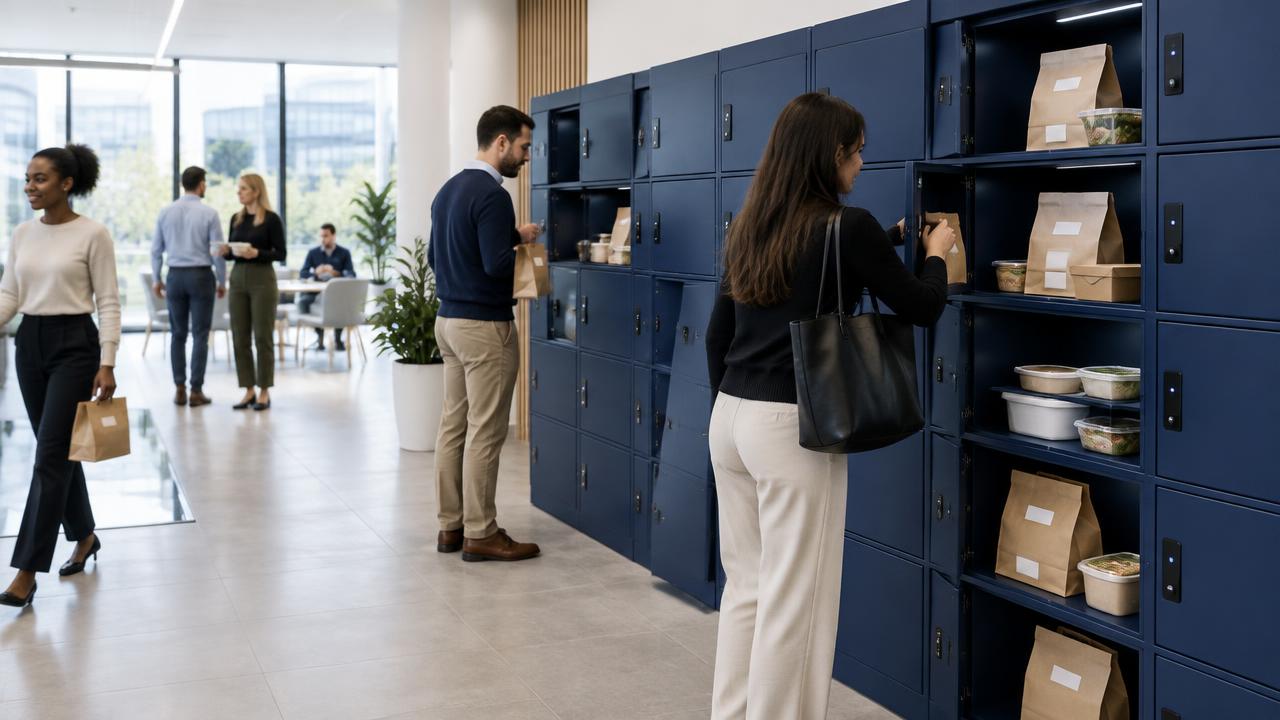
A smart food locker bank changes the job description. Instead of reception acting as a sorting office, the courier loads each named order straight into an allocated compartment. The locker matches the order to the recipient, sends a notification with a one-time PIN, and keeps the meal at the right temperature until collection.
The employee collects when their meeting ends. The facilities team never touches a bag. The provider's consolidated drop still happens — but it now terminates at a secure, temperature-controlled handoff point instead of a crowded reception desk.
- Named orders from Feedr or City Pantry load by recipient — no manual sorting
- Heated, chilled and ambient compartments hold food at temperature during the collection gap
- One-time PIN or QR collection creates an auditable chain of custody
- Multi-tenant routing sends each order to the correct company, floor or wing
Works with every provider model
The locker handoff is provider-agnostic. The same bank handles an individually ordered Deliveroo lunch, a Feedr Cloud Canteen named meal, a City Pantry event box, a Pret Delivers order and a Graze subscription. Couriers use the same touchscreen flow regardless of which platform sent them.
That matters because most offices end up running more than one provider. Deliveroo or Uber for ad-hoc individual ordering, Feedr for recurring subsidised lunches, City Pantry for team events, and direct restaurant accounts for special diets. A single handoff layer normalises all of them into one clean operational flow.
See also: Deliveroo for Business buyer's guide · platform comparison.
What to evaluate when choosing a provider
The platform decision and the handoff decision are independent. Choose the provider based on menu variety, subsidy model and reporting. Choose the handoff layer based on volume, building layout and how much facilities time you are willing to absorb.
- Does the provider support individually named orders and standing delivery instructions to a locker address?
- What temperature range does the food need between drop-off and collection?
- What is the collection window, and what happens to unclaimed meals?
- Can spend, dietary and allergy reporting feed into existing workplace systems?
- In multi-tenant buildings, can orders be routed to the correct company without cross-contamination?
If the daily headcount on site is predictable and you want a recurring programme, Feedr-style curated plans work well. If attendance is volatile and employees order individually, Deliveroo for Business or Uber for Business is usually more flexible. Either way, the last 30 metres inside the building is the part that breaks without lockers.
The business case
Removing the manual distribution step typically frees one to two hours of facilities or reception time per peak lunch day. Across a 250-person office operating five days a week, that is roughly 250–500 hours a year redirected from food triage to front-of-house, security and tenant experience work.
It also cuts the hidden waste line: fewer unclaimed meals thrown away, fewer re-heated or cold lunches sent back, and fewer failed deliveries because the recipient was in a meeting when the courier arrived. The platform handles ordering; the locker handles the physical economics.
Use the ROI calculator to size the reception-time and failed-delivery savings for your headcount, or book a 20-minute demo to see the locker handoff in action.