Deliveroo for Business vs Uber Eats for Business in London offices: a buyer's guide
Deliveroo for Business and Uber Eats for Business both give London teams expense-free lunches, late-night dinners and client catering on one bill. Here's how they compare, what they cost, where they fall down in secure office blocks, and how a Foodie Locker handoff point closes the last 30 metres.
Deliveroo for Business gives London teams a single corporate account for lunches, late dinners and client catering — with one bill, one set of policy controls and no personal-card-and-claim friction. It is the most adopted corporate food platform in the London market. Here is an honest buyer's guide for office occupiers, including where it stops working and how a lobby handoff point closes the last 30 metres.
What Deliveroo for Business actually is
A corporate account layer on top of Deliveroo. Admins set budgets per person per day, define eligible time windows (e.g. 12–2pm and 7pm–midnight), restrict cuisines or restaurants, and consolidate everything onto a single monthly invoice. Employees order from the regular Deliveroo app under their work account.
What it costs
Per-order pricing and consolidated billing. Most London teams use one of three patterns: a daily allowance (e.g. £12 per person per workday), an event-based budget (team lunches, client catering, late-shift dinners), or a hybrid. There is no per-seat licence — you pay for what you order.
Where it works well
- Team lunches that previously went through expense receipts
- Late-shift dinners for finance, law, agency and tech teams
- Client catering for meetings and pitches
- Hybrid offices where attendance peaks Tuesday–Thursday and the kitchen can't scale to match
Where it falls down — the last 30 metres
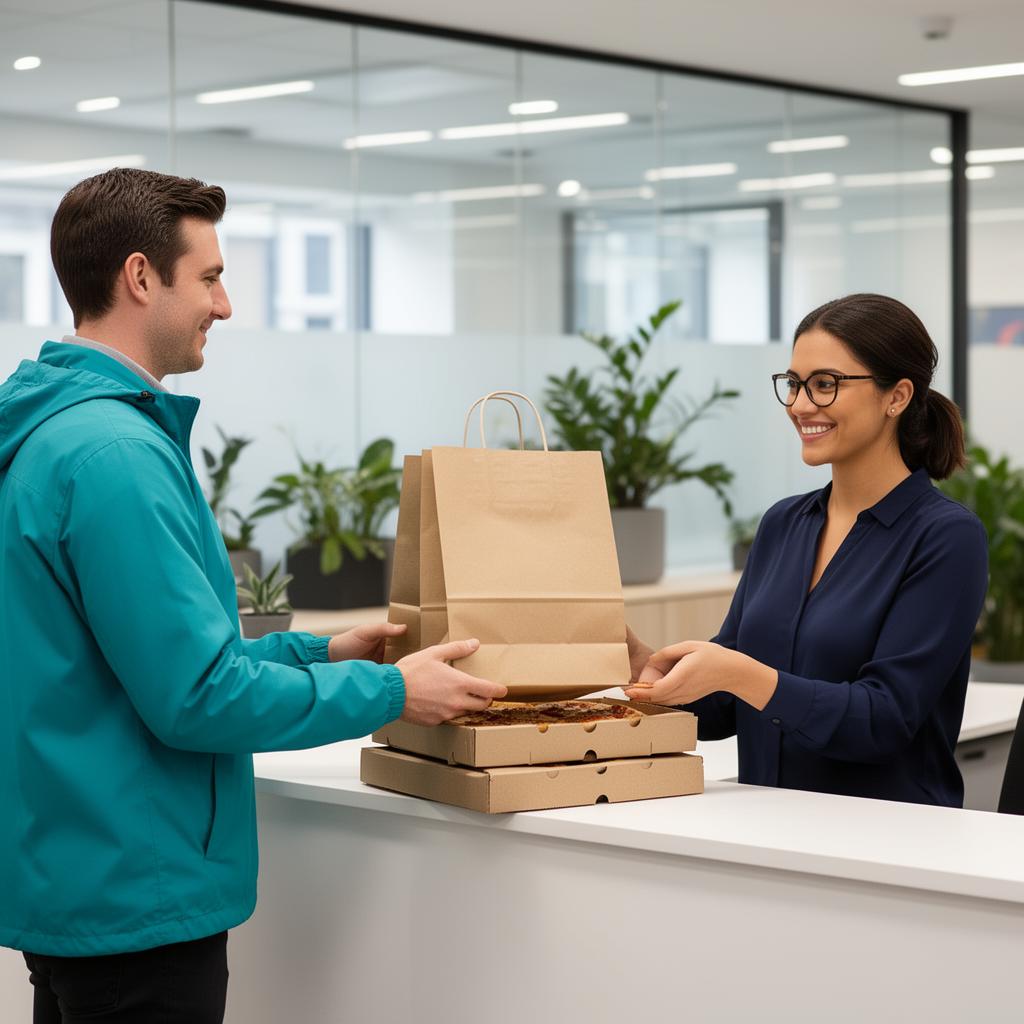
Deliveroo for Business solves ordering and billing. It doesn't solve the physical handoff. In a secure London office block, couriers can't get past reception or security. So the workflow usually becomes: courier rings reception, receptionist takes the bag, someone messages the recipient, recipient comes down (sometimes 15 minutes later), bag has gone cold, occasionally bag has gone missing.
Multiply that by 50 orders a day in a 200-person office and reception becomes a sorting office. This is the gap a Foodie Locker handoff point fills — the courier drops into a heated compartment, the recipient gets a PIN, reception never touches the bag.
How to specify it for a London office
Three decisions matter. First, the allowance model — daily vs event-based vs hybrid. Second, the policy guardrails — cuisine restrictions, time windows, alcohol on/off. Third, the handoff layer — reception-managed, dedicated drop shelf, or lobby smart locker. Most London occupiers of more than 100 people end up at smart locker; under 50 people can usually live with reception-managed.
See also: <a href="/blog/deliveroo-uber-just-eat-for-business-comparison-london" className="text-primary underline underline-offset-2">platform comparison</a> · <a href="/blog/office-food-delivery-london-secure-handoff" className="text-primary underline underline-offset-2">secure handoff problem</a>.