Hotel F&B without the kitchen: how smart food lockers deliver 24/7 guest dining
Budget and mid-market hotels can't profitably run a 24/7 kitchen — but guests still expect food on demand. Here's how a hybrid F&B model built around Foodie Locker, Deliveroo for Business and a 24/7 grab-and-go pantry replaces room service, fills the late-night gap and turns F&B from a cost centre into a guest-satisfaction lever.
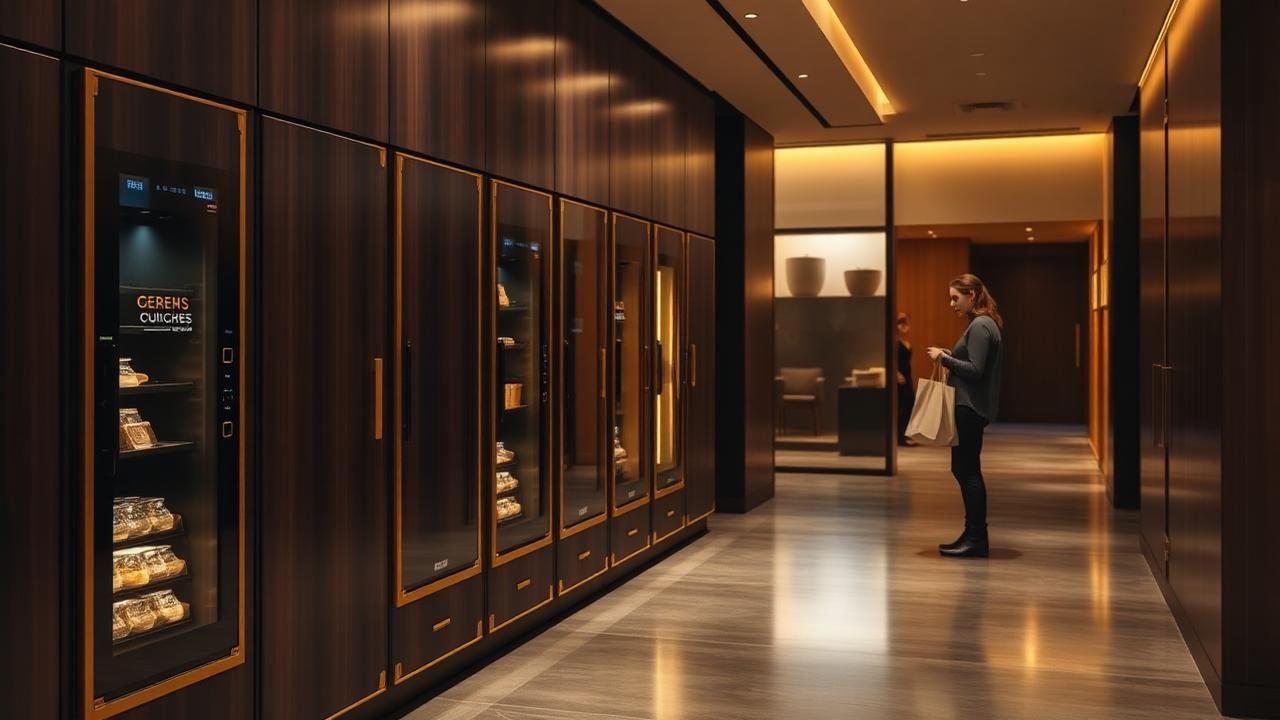
For most budget and mid-market hotels, running a full F&B operation is a losing trade. A 24/7 kitchen needs a brigade, a stockroom, a HACCP regime and a P&L that rarely closes in the black. But guests still expect food on demand — at 11pm after a delayed flight, at 6am before an early meeting, and at every hour in between. The smartest answer the industry has landed on is a hybrid F&B model: a small 24/7 grab-and-go pantry, a curated delivery partnership with Deliveroo and Uber Eats, and a secure Foodie Locker handover point that ties the two together.
The economics: why in-house F&B no longer works for budget and mid-market hotels
Industry analysts (HotStats, STR, Boutique Hotelier) all point in the same direction. Outside of luxury and resort properties, in-house F&B at budget and mid-market hotels is structurally unprofitable. Labour costs run 35–45% of F&B revenue. Food cost-of-sales sits above 32% even at well-run properties. And demand is bimodal — empty for hours, then a 30-minute peak the kitchen can't keep up with.
The result is the worst of both worlds: a guest experience that disappoints (limited menu, slow service, closes at 10pm) and a P&L that subsidises the disappointment.
The hybrid model: keep, offload, partner
The smartest operators are converging on a three-part model.
- Keep — a 24/7 grab-and-go pantry stocked with sandwiches, salads, snacks, fresh fruit, hot drinks and grab-and-beer/wine. Low overhead, high margin, no kitchen.
- Offload — a curated partnership with Deliveroo, Uber Eats and Just Eat, surfaced through QR codes in the room and on the lobby touchscreen.
- Partner — local restaurants pre-vetted for quality, with prepaid corporate accounts and a defined handover point in the lobby.
Foodie Locker is the piece that makes the second and third legs work. Without a secure handover point, third-party delivery becomes a reception headache — couriers buzzing rooms, bags on the front desk, guests in robes wandering the lobby. With one, the courier drops, the guest collects, and reception never touches the bag.
Filling the late-night gap
The biggest single F&B complaint at budget hotels is 'no food after 10pm'. The hybrid model solves this directly. The grab-and-go pantry runs 24/7 (self-serve, card-only). Deliveroo runs until 3am in most UK cities. Foodie Locker is on 24/7 by definition. A guest checking in at 1am can order a hot meal from a real restaurant, collect it from a heated locker in the lobby, and eat it in their room — without any staff involvement.
That is a better experience than any budget hotel kitchen could ever deliver, at a fraction of the cost.
What Foodie Locker contributes
A heated, chilled and ambient locker bank in the lobby gives the hotel:
- A secure 24/7 handover point for Deliveroo, Uber Eats and Just Eat orders — no reception time, no theft, no mix-ups
- Heated compartments that hold food at serving temperature for up to 90 minutes — so a 1am check-in doesn't mean a cold meal
- Chilled compartments for grocery deliveries and meal-kit subscriptions — useful for long-stay guests and aparthotel-style properties
- A branded touchscreen that can upsell the in-house pantry, mini-bar replenishment or breakfast pre-orders at the point of collection
- Full audit trail — every drop and pickup logged, useful for billing dispute resolution and security
Better than a vending machine — and complementary to one
A vending machine solves the snack problem. It does not solve the meal problem. Foodie Locker sits alongside any existing vending offer and extends it into hot food, full restaurant meals and grocery deliveries. The two are complementary, not competitive — most hotel operators end up with both.
Commercial outcomes
Hotels running the hybrid model report three measurable shifts. First, F&B complaint volume drops sharply — guests no longer rate the property down for a missing or limited kitchen. Second, late-night ancillary spend rises, because guests who would have gone to bed hungry now order in. Third, reception labour is freed up — the 20–40 minutes per shift previously spent triaging delivery bags goes back to actual hospitality.
For a deeper look at how the same infrastructure plugs into the hotel guest app, see <a href="/blog/integrating-foodie-locker-hotel-app-pms-standalone-deployment" className="text-primary underline underline-offset-2">our deployment guide</a>. To talk through what this means for a specific property, <a href="/contact" className="text-primary underline underline-offset-2">book a demo</a>.