
The quiet rise of grocery-by-app: how Whoosh, Hop and Joybuy are reshaping building deliveries
Tesco Whoosh, Sainsbury's Chop Chop, Deliveroo Hop and Joybuy have shifted the UK weekly shop into 4–6 small drops a week. Lobbies were never designed for that. Here's why chilled smart lockers are quietly becoming the default infrastructure for grocery-by-app in residential buildings.
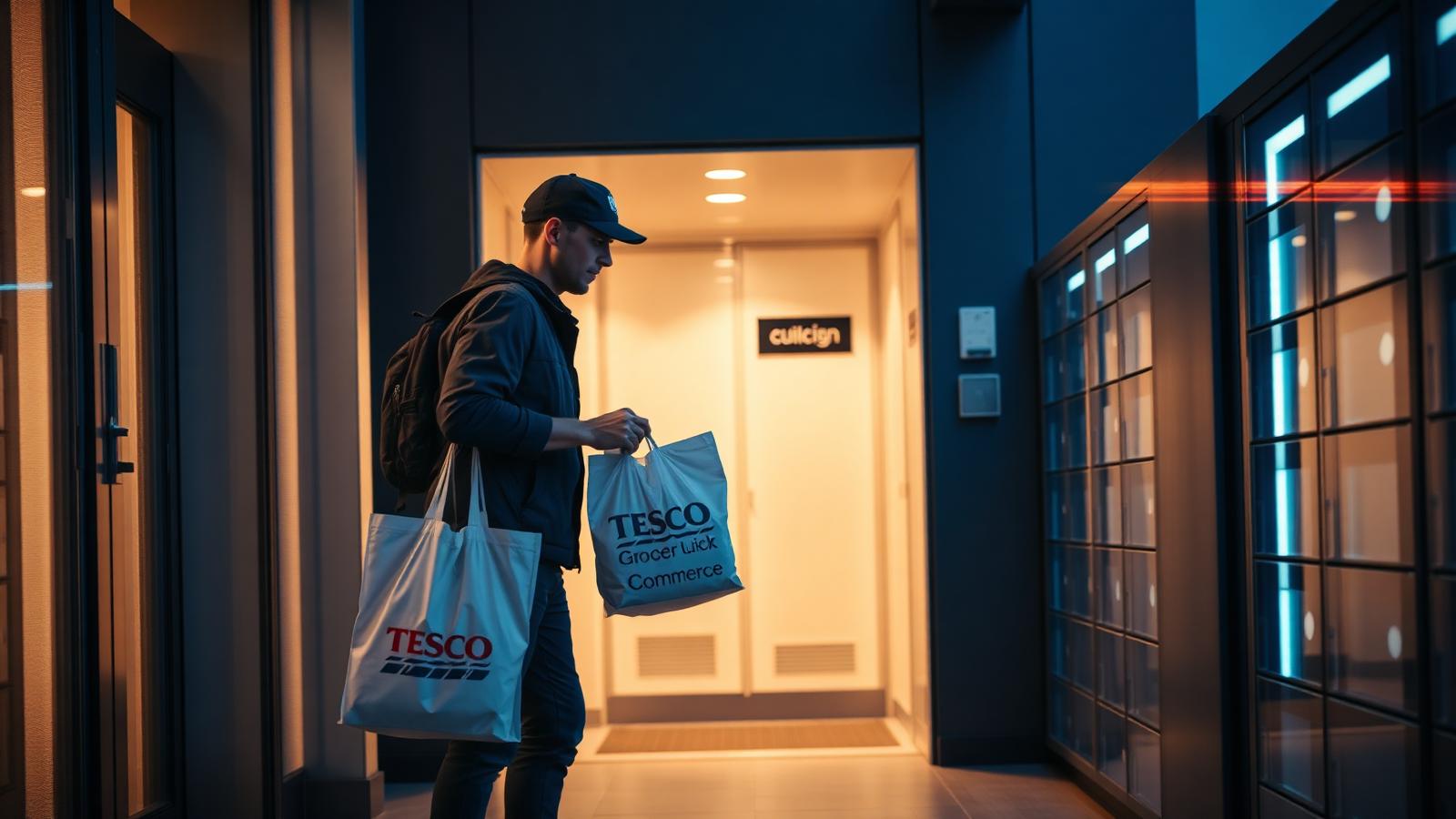
Five years ago, the UK weekly shop was one big trolley dragged through Tesco on a Saturday. Today it's four-to-six small drops a week — Tesco Whoosh in 30 minutes, Sainsbury's Chop Chop on the way home from work, Deliveroo Hop for the wine you forgot, Joybuy for the pantry top-up, Amazon Fresh for the heavy stuff. The shopping basket has fragmented. Lobbies, lifts and concierge desks were never designed for that traffic pattern — and the cracks are starting to show.
This is the quiet story behind quick-commerce: it's not just speed, it's frequency. And on that frequency curve, the building infrastructure breaks long before the courier network does. Smart chilled lockers are emerging as the default fix, and the operators who get there first are about to own the conversation.
From one big shop to six small ones
Quick-commerce in the UK has gone from novelty to habit in under three years. Tesco Whoosh now covers ~1,400 stores. Sainsbury's Chop Chop runs out of city-centre supermarkets in 60 minutes or less. Deliveroo Hop has dedicated dark-store partnerships with Morrisons, Waitrose, Co-op and Boots. Getir's UK exit was misread as a category collapse — what actually happened is the supermarkets absorbed the playbook and ran it at scale.
Joybuy is the latest entrant — JD.com's UK launch — bringing Chinese-style hyper-frequent grocery direct to consumers, with a heavy emphasis on chilled and frozen drops in 1–2 hours. The pattern is identical to what reshaped delivery in Shanghai and Shenzhen a decade ago: residents stop planning the weekly shop and start ordering little and often, multiple times per week, mostly to home.
The behavioural shift matters because it changes the unit of analysis. A building no longer absorbs one Ocado van on a Thursday — it absorbs 30+ small grocery drops a day across half a dozen apps, half of them chilled.
Why the lobby is the bottleneck, not the courier
Quick-commerce platforms have solved the courier supply, the routing and the unit economics. What they haven't solved is the last 50 metres inside the building. That part is the operator's problem — and it shows up as:
- Concierge desks acting as a chilled fridge for 40 grocery bags a day
- Couriers buzzing flats during work hours with perishables when the resident is in a meeting
- Bags left on the floor by the lift, leaking, with raw chicken in 22°C lobbies
- Doorstep theft of grocery bags becoming a weekly complaint, not a one-off
- Residents giving up on the platform because 'the building can't handle it'
Chilled lockers: the missing infrastructure layer
The food-locker conversation is still mostly framed around hot takeaway. That framing is already out of date. Volumetrically, grocery and quick-commerce drops are overtaking takeaway in many BTR and PBSA buildings — and they have a much harder requirement: they need to be chilled, scheduled and signed for.
A chilled smart locker bank handles all three. Couriers drop into a temperature-controlled compartment, the resident gets a notification with a one-time PIN, and the food sits at 2–8°C until they collect — minutes or hours later. The platform gets a delivery confirmation; the building gets an audit trail; the resident gets their groceries without taking a meeting break.
Why this is bigger than takeaway
Three reasons the grocery story is the bigger long-term play for residential operators:
- Frequency: a quick-commerce user places 4–6 orders a week vs 1–2 takeaways. The infrastructure that handles groceries handles takeaway as a free side-effect — not the other way around
- Stickiness: residents who switch to building-based grocery collection don't switch back. It's the kind of amenity people factor into renewal decisions
- Sustainability: chilled lockers consolidate drops into a single trip per courier. Operators with ESG targets get a measurable scope-3 win without changing resident behaviour
What good looks like in 2026
A grocery-ready locker bank in a UK residential building should ship with chilled, ambient and frozen compartments; standing courier instructions registered with Tesco Whoosh, Sainsbury's, Hop, Joybuy and Amazon Fresh; geocoded drop points so couriers don't get lost on multi-core campuses; and an audit log the operator can pull for any drop, any day, in seconds. Anything less and you're patching the takeaway problem while the grocery wave breaks over the lobby.
Related reading: Cloud kitchens and the end of cooking at home · Designated drop zones for multi-core campuses.