The future of food delivery: cloud kitchens, dark kitchens and the end of cooking at home
Travis Kalanick believes ordering delivery from cloud kitchens will soon be cheaper than buying groceries and cooking at home. Here's how cloud kitchens, dark kitchens, robotics and subscription delivery are reshaping how the world eats — and what it means for residential buildings.
Key takeaways
- Cloud kitchens are commercial facilities built only for delivery — multiple restaurant brands run from one purpose-built kitchen with no dining room.
- Dark kitchens are delivery-only outposts of a single existing brand; ghost kitchens is a synonym for cloud kitchens.
- Travis Kalanick (founder of CloudKitchens, ex-Uber CEO) argues at the 2024 All-In Summit that delivery from cloud kitchens will soon be cheaper than buying groceries and cooking at home.
- The drivers: bulk procurement, robotics, software-routed couriers, zero front-of-house overhead, and subscription meal plans that work like Netflix or a mobile contract.
- The remaining bottleneck is the last 50 metres — courier-to-resident handover. Smart food lockers solve it.
- Buildings that install insulated smart food lockers now will absorb 10–14 weekly resident deliveries without lobby chaos; those that don't will buckle.
In a recent All-In Summit interview, former Uber CEO and CloudKitchens founder Travis Kalanick laid out a striking thesis: within a decade, ordering food from a cloud kitchen will be cheaper than buying the ingredients at the supermarket and cooking dinner at home. Subscription meal plans, robotic prep, hyper-dense delivery routing and purpose-built infrastructure will collapse the cost of a hot, restaurant-quality meal — to the point where home cooking becomes a hobby, not a household necessity.
If that sounds extreme, remember: the same was once said about hailing a taxi, sending a parcel overnight, or streaming any film ever made. The technologies that make food delivery cheaper than groceries are already being built — in cloud kitchens, dark kitchens, robotic kitchens and the smart-locker last-mile layer that connects them to where people actually live.
What is a cloud kitchen (and how is it different from a dark kitchen)?
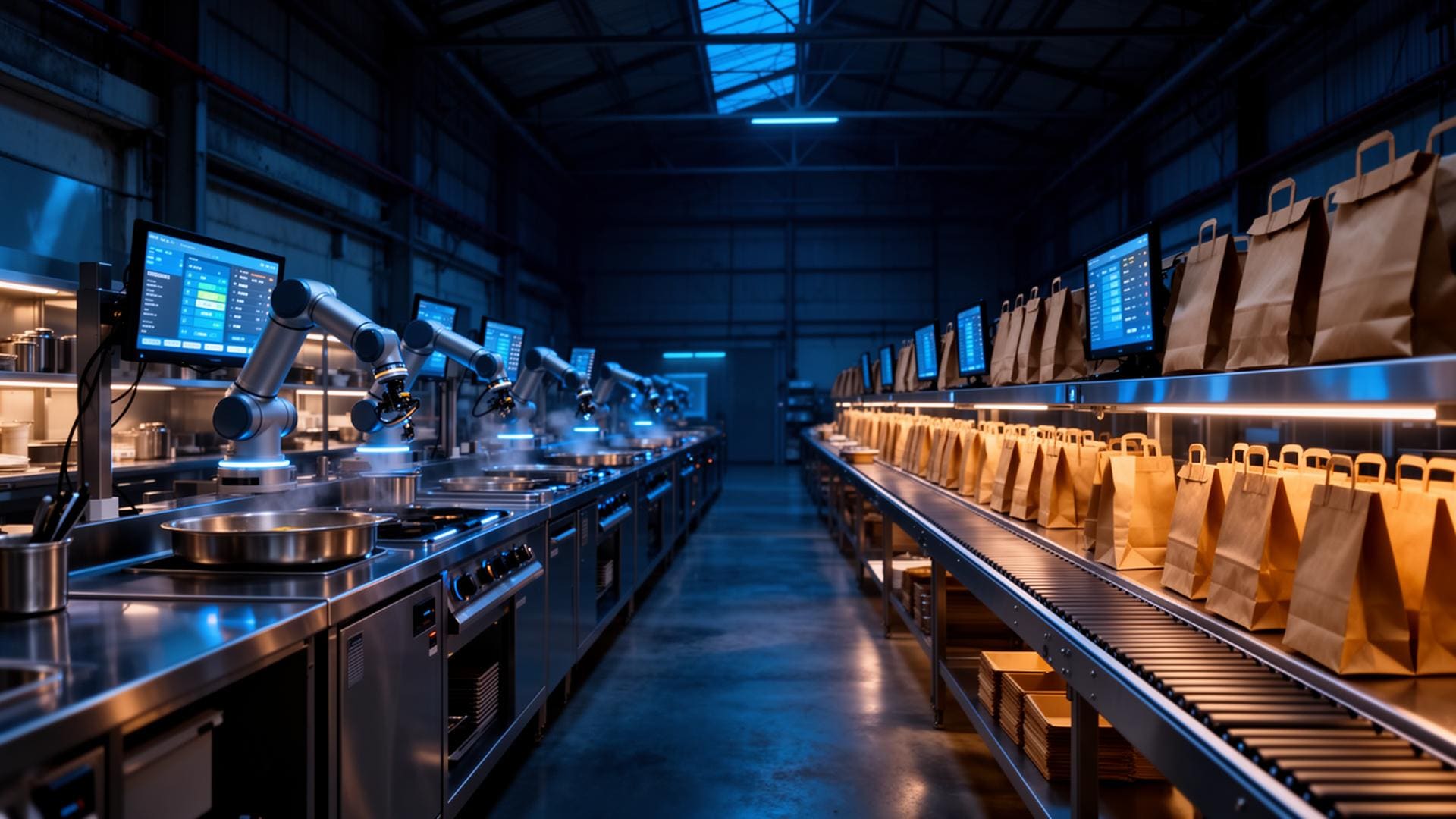
A cloud kitchen is a commercial kitchen built specifically for delivery. There is no dining room, no waiters and no walk-in customers — only kitchens, packaging stations and a courier handover zone. Multiple restaurant brands often operate out of a single cloud kitchen building, sharing the infrastructure but running independent menus, brands and P&Ls.
"Dark kitchen" and "ghost kitchen" are sometimes used interchangeably with cloud kitchen, but the distinction is useful: a dark kitchen is typically a single delivery-only outpost run by an existing restaurant brand, while a cloud kitchen is purpose-built infrastructure that hosts many brands at once. CloudKitchens (the company founded by Travis Kalanick under City Storage Systems) is the largest example, with over 100 facilities in the US and operations in more than a dozen countries.
Why Travis Kalanick believes delivery will be cheaper than groceries
Speaking at the 2024 All-In Summit, Kalanick argued that cooking at home carries enormous hidden costs that consumers underestimate — supermarket margins, food waste, cooking time, energy, dishwashing, and the value of the labour involved. Cloud kitchens, by contrast, can drive every variable down through scale and software:
- Bulk ingredient procurement at industrial pricing
- Single-skill stations and robotics that compress prep time per dish
- Zero front-of-house overhead (no rent, servers, decor or table turnover)
- Software-routed couriers that batch deliveries within minutes of each other
- Subscription models that smooth demand and lock in volume for the kitchen
- Near-zero food waste through precise, demand-aggregated cooking
The result, in Kalanick's framing, is that food delivery becomes a utility — like electricity, mobile data or streaming — rather than a luxury. Subscription bundles will offer unlimited or capped meals at a flat monthly price, just like a Netflix or mobile contract. People will eat the way they communicate today: through a network, on demand, without thinking about the underlying infrastructure.
Robotics and the cost curve
Cloud kitchens are increasingly automated. Robotic woks, frying arms, automated assembly lines and AI-driven order orchestration mean a single facility can produce thousands of meals an hour with a fraction of the kitchen staff a traditional restaurant would need. Each step that becomes software is a step that gets cheaper, faster and more consistent over time.
This is the same pattern that drove down the cost of computing, storage and bandwidth. Apply it to food, and a £15 delivery meal in 2026 looks structurally similar to a £150 mobile phone bill in 2002 — destined to become unrecognisably cheaper as the underlying tech compounds.
Subscription is coming for dinner
Picnic, Kalanick's digital food court launched in 2024, already hints at the model: residents and office workers in San Francisco and Mountain View can order from 100+ restaurants with no delivery fees and no tips, paid for by aggregating demand into single-drop runs. Scale that up, add monthly meal subscriptions, and you have something closer to a streaming service than a takeaway app.
Expect the next decade to bring three flavours of subscription food: open-marketplace bundles (any restaurant, capped meals/month), curated chef plans (rotating cuisines from a single cloud kitchen), and building-led plans (the operator pre-negotiates a meal subscription as a resident amenity).
Why the last 50 metres still decides who wins
Cloud kitchens collapse the cost of producing a meal. But the bottleneck has moved: the most expensive, error-prone and emissions-heavy part of food delivery is now the last 50 metres — the handover from courier to customer at the door of a building. This is exactly where most current delivery experiences still fall apart: cold food, missed buzzers, lobby chaos, theft and frustrated couriers.
If delivery is going to become a utility, the last-50-metre layer needs to become utility-grade infrastructure too. That means insulated smart food lockers in every residential, student, hotel and workplace building — not as a niche amenity, but as a standard fitting like wifi, mailboxes and lifts.
What this means for residential buildings
Once cloud-kitchen subscriptions are mainstream, the average resident won't be receiving 2–3 deliveries a week — they'll be receiving 10–14. Buildings without dedicated infrastructure will buckle: lobbies turn into courier waiting rooms, concierges become full-time triage staff, and resident satisfaction collapses.
Buildings with smart food locker infrastructure will sail through. Couriers drop dozens of orders in minutes. Residents collect on their schedule with a one-time PIN. Operators get a clean audit trail and a new revenue layer through advertising, sponsored placements and partner-restaurant margins. The building becomes part of the cloud-kitchen network, not a friction point in front of it.
Where Foodie Locker fits in the future of food delivery
Foodie Locker is the building-side infrastructure layer for the cloud-kitchen era. Insulated compartments. Open APIs that integrate directly with cloud-kitchen orchestration platforms, courier networks and resident apps. Group-order workflows for subscription bundles. Audit trails, analytics and monetisation tools for the operator.
If Travis Kalanick is right and delivery becomes cheaper than groceries, the buildings that win will be the ones that designed for it early — and the operators that turn that infrastructure into both a resident amenity and a recurring revenue line.
How to prepare your buildings now
- Specify insulated food lockers at planning stage in every new BTR, PBSA, hotel and office scheme
- Retrofit existing lobbies before delivery volumes spike further — the curve is steepening, not flattening
- Choose locker infrastructure with open APIs so it can plug into cloud kitchens, courier platforms and subscription services as they mature
- Treat the resident app and locker network as one product — not two unrelated bits of tech
- Track utilisation, dwell time and resident NPS from day one, so you can prove the ROI internally