
The University Estates Director's guide to the smart campus
What a smart campus really is, where universities are investing, and how to build the business case — a practical guide for Estates and Facilities leaders.
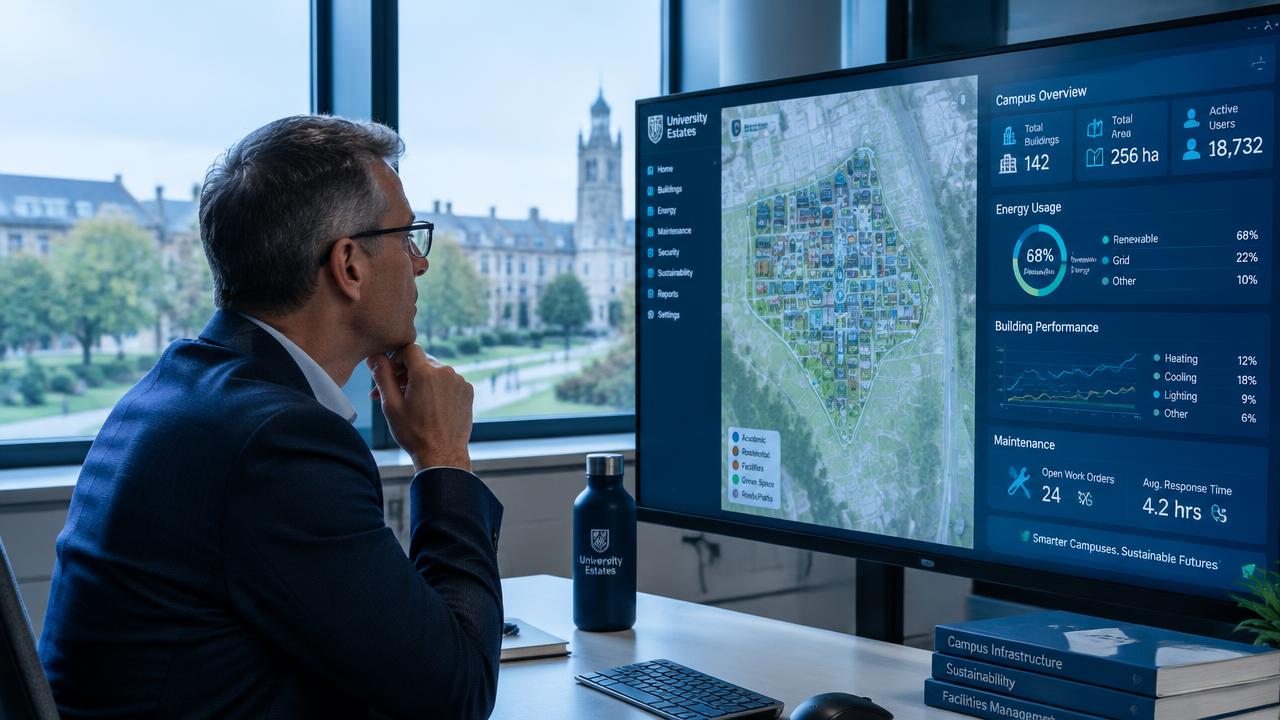
A smart campus is not a product you buy. It is an estate where buildings, services and people generate data that helps you make better decisions — about space, energy, safety, maintenance and the student experience.
This guide is written for Estates Directors, Heads of Facilities and Campus Operations leads who need a clear view of where the sector is investing, what delivers value first, and how to build a business case that survives a finance committee.
What is a smart campus?
A smart campus connects the physical estate to digital systems so that it can be measured, managed and improved continuously. In practice that means four layers:
- Sensing — meters, sensors, access readers and connected devices that capture what is happening
- Platforms — systems that store, combine and present that data (IWMS, BMS, CAFM, access control)
- Services — the student- and staff-facing experiences built on top (booking, access, collection, reporting)
- Decisions — the governance that turns data into action and investment choices
Most universities have pieces of all four. The smart campus challenge is joining them up and deciding what to add next.
Where universities are investing
Published UK estate strategies repeat the same priorities: safe and welcoming campuses, better student experience, data-led space management, net zero, operational efficiency and financial resilience. Surrey's 2026–41 strategy talks about smart digital estates and technology-enabled user experience; UCL's MyCampus programme brings estate information and service requests into one platform.
The common thread is moving from reactive, manual operations to measured, self-service ones.
Smart building management and predictive maintenance
Building management systems and condition monitoring allow estates teams to prioritise the maintenance backlog by risk rather than by complaint. Start with high-disruption plant — lifts, boilers, air handling — where good data already exists.
Energy, IoT and net zero
Half-hourly metering, automated tuning and occupancy-linked controls are core to any credible net zero plan. Pair energy work with occupancy data so you are not optimising buildings that should be closed.
Space utilisation
Anonymous occupancy sensing plus timetable data reveals booked-but-empty rooms and overflowing study spaces. It is the capability most directly linked to avoided capital spend.
Access, security and visitor management
Mobile credentials, time-bound permissions and digital visitor management make safety policy enforceable. Once access is digital, rules like “no third-party couriers beyond the perimeter” can actually be applied.
Parcel management
Automated parcel lockers moved parcel handling from reception desks to self-service. They proved an important point: students readily use self-service collection, and reception workload falls sharply when they do.
Food delivery infrastructure
Food is the logistics stream most campuses still leave unmanaged. Takeaways, groceries, meal kits and subscriptions arrive late, in volume and from drivers unfamiliar with the estate. Some universities require students to meet couriers outside; others staff overnight collection points manually. A designated campus food delivery hub with insulated self-service lockers turns that into managed, measurable infrastructure.
In one 840-bed student residence, Foodie Locker handled 2,232 deliveries — around 72 a day — with roughly two-thirds collected within 20 minutes.
Campus apps and student experience
Students judge the campus by moments: getting into a building, finding a room, receiving a delivery at 10pm. A campus app is only as good as the services behind it. See our guide to improving the student experience through campus facilities.
Data and KPIs
- Space utilisation by building and hour
- Energy intensity and progress against net zero targets
- Planned vs reactive maintenance ratio
- Security incidents and access exceptions
- Reception and front-of-house time spent on logistics
- Delivery volumes, peak hours and collection times
- Student satisfaction with facilities
Building the business case
Strong smart campus business cases quantify three things: staff time released, risk reduced and experience improved. Start with a small, measurable pilot, agree KPIs up front and scale what proves itself.
Some infrastructure can be deployed with no capital at all — Foodie Locker's fully funded model has £0 capex and £0 monthly fee. Use the ROI calculator to model the impact on your estate.