
10 smart campus innovations university estates & facilities teams should be watching in 2027
From digital twins and predictive maintenance to smart access control and centralised food delivery hubs — the ten technologies shaping university estates strategy in 2027.
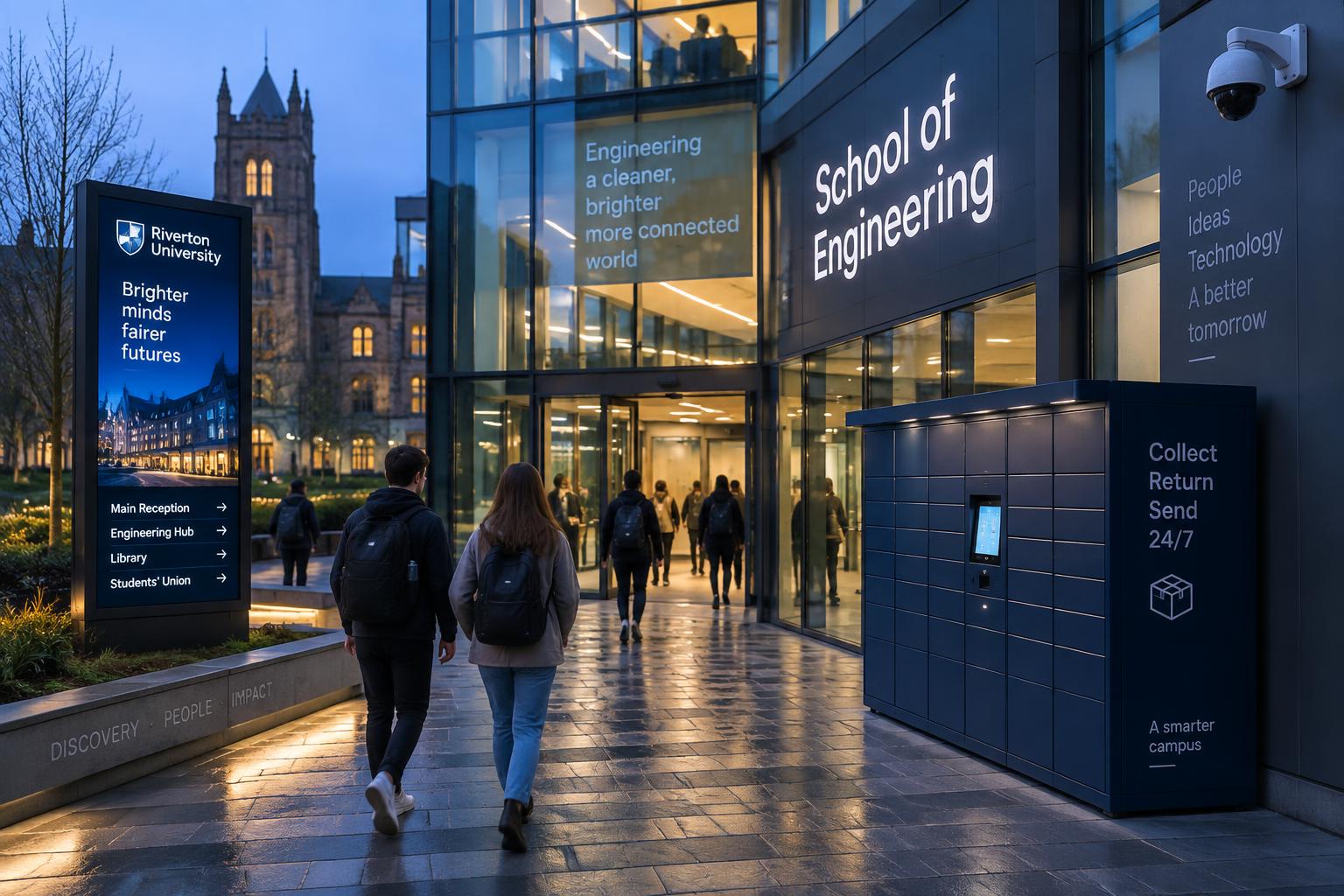
University estate strategies are converging on the same themes: safe campuses, better student experience, smart and digital estates, space utilisation, net zero, operational efficiency, data and financial resilience. The question for Estates Directors, Heads of Facilities, Campus Operations and Residential Services leads is no longer whether to digitise the estate, but which capabilities deliver measurable value first.
This guide sets out ten technologies worth watching in 2027 — what each one does, what it improves, and how to judge whether it earns a place in your capital or revenue plan. Some are mature. Some are emerging. One of them, food delivery infrastructure, isn't yet routinely treated as a smart-campus system at all — and that gap is costing estates teams time, money and control.
1. Smart building sensors and IoT
Environmental and asset sensors — temperature, humidity, CO₂, water flow, vibration, door state — turn buildings from black boxes into data sources. The value isn't the sensor; it's the decisions it enables: shutting down over-ventilated spaces, spotting a leak before it reaches a lecture theatre, evidencing compliance without a clipboard.
What to look for: open protocols, data that lands in a platform you control, and a clear owner for the alerts. Sensor estates fail when nobody is accountable for acting on what they report.
2. AI-assisted predictive maintenance
Reactive maintenance is the most expensive way to run an estate. Predictive models use asset data, work-order history and condition monitoring to forecast failures and schedule interventions during vacation periods rather than freshers' week.
The realistic near-term win is triage: prioritising the backlog by risk and cost rather than by who shouted loudest. Start with plant that has both good data and high disruption cost — lifts, boilers, AHUs, chillers.
3. Digital twins
A campus digital twin is a live, data-connected model of the estate used to test scenarios before spending money: what happens to utilisation if two departments merge, how a refurbishment affects energy, where circulation pinch points will appear.
Digital twins are only as good as the underlying data discipline. If your space data, asset register and floor plans disagree, fix that first — the twin will simply broadcast the inconsistency at higher resolution.
4. Smart access control
Mobile credentials, time-bound permissions and centrally managed door groups are quietly one of the highest-return investments on campus. They reduce key management overhead, allow 24/7 access to selected spaces without staffing them, and produce an audit trail when something goes wrong.
Access control is also the backbone of safety policy. Once permissions are digital, rules like “contractors only during booked hours” or “no third-party couriers beyond the perimeter” become enforceable rather than aspirational.
5. Occupancy monitoring and space utilisation
Most universities are simultaneously short of space and paying to heat rooms nobody uses. Anonymous occupancy sensing plus timetable data shows the real picture: which rooms are booked and empty, which study spaces overflow at 9pm, which buildings could be consolidated.
This is the capability most directly tied to financial resilience. Every square metre released or repurposed is avoided capital spend.
6. Energy optimisation and net zero reporting
Half-hourly metering, automated building tuning and demand-response controls are now standard components of a credible net zero pathway. The reporting layer matters as much as the hardware: trustees, funders and students all want progress evidenced, not asserted.
Pair energy work with occupancy data. Optimising the heating schedule of a building that shouldn't be open is the wrong answer delivered efficiently.
7. Smart parcel lockers
Parcel volumes into halls of residence have grown steadily, and most universities solved it the same way: a reception desk, a store room and staff time. Automated parcel lockers move that to self-service, removing manual logging, chasing and liability for held items.
Parcel lockers are now well understood by estates teams. The important observation is what they prove — that students will happily use self-service collection infrastructure, and that reception workload falls sharply when they do.
8. Centralised food delivery hubs
This is the gap. Parcels have a strategy; food generally doesn't. Yet food, grocery, meal-kit and subscription deliveries now arrive on campus in far greater volume than parcels, at unsociable hours, from couriers with no campus relationship, to students who expect to eat within minutes.
The operational consequences show up across every other theme on this list: couriers tailgating into residential blocks (security), drivers circling campus looking for Block C (sustainability and traffic), reception fielding “has my order arrived?” (efficiency), and students meeting strangers outside at 11pm (safeguarding and experience).
A centralised food delivery hub is the same idea as a parcel locker applied to a harder problem: a designated, geocoded, lit and monitored collection point with insulated compartments, PIN or QR release and a full audit trail. Couriers get one destination and a 30-second drop. Students collect when they want. Estates teams get data instead of anecdotes.
The volumes justify treating it as infrastructure. At one 840-bed student residence using Foodie Locker, the system handled 2,232 food deliveries in a single month — around 72 a day — with 66.7% collected within 20 minutes. That is not an occasional visitor-management issue; it is a daily logistics flow with no owner on most campuses.
See how this works estate-wide on our university and student campus page.
9. Campus apps and digital wayfinding
A single app that carries timetables, room booking, maintenance reporting, access credentials, collection notifications and navigation is the interface students actually judge the estate by. Wayfinding in particular has outsized impact on accessibility, safety after dark and the experience of visitors and new students.
Extend wayfinding beyond students. Precise drop-point data — geocoded locations, entrance imagery, standing instructions — is what stops couriers and contractors from wandering an estate designed for pedestrians.
10. Automated visitor and contractor management
Digital pre-registration, self-service check-in, induction capture and time-bound passes replace paper logs and give you an accurate, real-time record of who is on site. In an emergency that record is the difference between a roll call and a guess.
The same framework should answer an awkward question most universities haven't formally addressed: what category does a food delivery courier fall into, and what are they permitted to do? Designated delivery infrastructure answers it by design — couriers never need to be visitors at all.
How to prioritise in 2027
A simple filter for any smart-campus proposal:
- Does it remove recurring manual work, or add a new system to manage?
- Does it produce data you will actually act on, with a named owner?
- Does it improve safety or experience in a way students would notice?
- Can it be funded from operational savings or third-party revenue rather than capital?
- Does it integrate with what you already run, or create another island?
Judged against that filter, self-service collection infrastructure scores unusually well: it removes reception workload, creates an audit trail, is visible to every resident, and — in Foodie Locker's fully funded model — can be deployed with no capital outlay and no monthly fee, with the building sharing in commercial revenue.
The capability most campuses are missing
Universities have invested seriously in access control, energy, space and parcels. Food delivery has been left to solve itself, which in practice means it is being solved at the reception desk, at the door of a hall, and on the pavement outside at 11pm.
Treating food delivery as estate infrastructure — not a nuisance — is the innovation most likely to show up in campus strategies over the next two years. To see what it looks like on a real estate, review the operator proposition or book a campus walkthrough.