
How to stop food couriers entering your apartment building (without banning delivery)
A step-by-step guide for UK building managers on how to stop food delivery couriers entering your apartment building — without banning Deliveroo, Uber Eats or Just Eat. Covers perimeter-accessible lockers, intercom rules, concierge scripts, signage, Building Safety Act mapping and the policy wording that makes it stick.
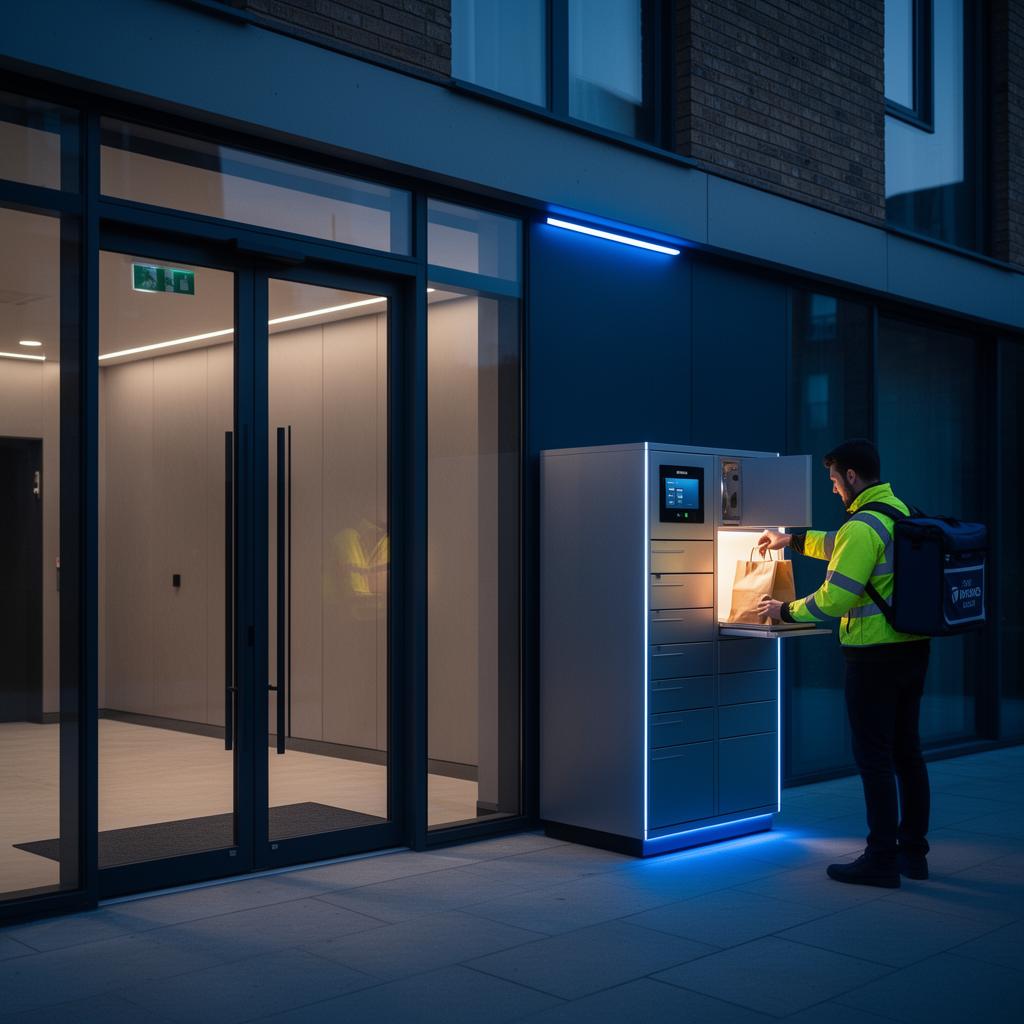
Most UK apartment buildings are quietly losing control of who comes through the front door — and food delivery couriers are the largest single category. Buzzed in by residents, tailgated through fire doors, roaming corridors at midnight. The instinct of many building managers is to ban deliveries outright. That fails: residents revolt, couriers loiter on the pavement, and the safeguarding problem moves a metre outside the door rather than disappearing.
This guide shows you exactly how to stop food delivery couriers entering your apartment building without banning Deliveroo, Uber Eats or Just Eat — using perimeter infrastructure, a written access rule, intercom changes, concierge scripts and signage that hold up under scrutiny from residents, regulators and your insurer.
Why banning delivery is the wrong fix
Outright courier bans have been tried in luxury London buildings and consistently fail for three reasons. First, residents pay for convenience and will route around the ban via guest access, propped doors and concierge favours. Second, couriers cluster on the pavement creating noise, litter and a worse street-frontage than they ever created in the lobby. Third, lone residents end up meeting couriers in the dark on the public footway, which is a safeguarding step backwards.
The right framing isn't 'stop deliveries' — it's 'stop couriers crossing the building threshold'. That distinction is what makes the rest of this playbook work.
Step 1 — Install a perimeter-accessible drop point
Nothing else on this list works without infrastructure. You need a single, named drop location that is accessible to couriers 24/7 without entering the building. In practice that means a perimeter-mounted smart food locker bank — externally facing, weatherproofed, with insulated compartments, and registered as the official drop address with every major delivery platform.
Once that exists, the courier never has a legitimate reason to be inside the building. Every other control on this list is enforcement of that single architectural fact.
Step 2 — Register the locker as the official delivery address on every platform
This is the step most operators skip and then wonder why couriers still buzz the intercom. You need to update the address record on Deliveroo, Uber Eats, Just Eat, Tesco Whoosh, Sainsbury's Chop Chop, Deliveroo Hop and the major meal-kit subscriptions so the geocoded drop pin lands on the locker bank, not the front door.
- Set the delivery-instruction field to 'Drop at the Foodie Locker bank — do not enter the building or buzz the intercom'
- Use a what3words tag for the exact locker location where the platform supports it
- Email each platform's operations team with the change and request the geocode pin be moved
- Brief residents to update their own saved addresses inside the apps with the same instruction text
Step 3 — Disable intercom and door-release for delivery couriers
Most courier entries happen because a resident absent-mindedly buzzes the door open when 'Deliveroo' is on the intercom. Remove that as a possibility. Modern intercoms can be configured to disable resident-side door release for outside-buzzer events between defined hours, or to require a positive video confirmation before release. At minimum, between 11pm and 7am the intercom should not be able to release the front door at all for delivery couriers.
Pair this with a clear concierge instruction: under no circumstances does the concierge release the front door for a delivery courier. The drop point is outside.
Step 4 — Write the courier access rule into the resident handbook
Infrastructure without policy doesn't survive its first dispute. The single most useful sentence to add to the resident handbook is:
"Food and grocery delivery couriers are not admitted into the building. All food and grocery deliveries are placed in the Foodie Locker bank at the [named entrance] and collected by the resident using a one-time PIN."
That one sentence gives the concierge cover to say no, gives the resident a clear expectation, gives the insurer a written control, and gives the Accountable Person a documented evidence trail under the Building Safety Act 2022.
Step 5 — Brief the concierge with a 30-second script
The concierge is the human firewall. They need a short, confident script for the three scenarios that will absolutely happen in week one:
- Courier at the desk: 'All food and grocery deliveries go into the locker bank at the south entrance. I can't let couriers into the building — it's a Building Safety policy. The locker screen will guide you through the drop.'
- Resident pushing back: 'I understand it's a change. The locker keeps your food hot and means I'm not paging you every time something arrives. You'll get a PIN by text the second it's dropped.'
- Courier on intercom: front-door release is disabled for intercom 'delivery' buzzes. Concierge directs the courier verbally to the locker bank and ends the call.
Step 6 — Signage at every door, lift landing and lobby screen
Most courier entries happen because nobody told the courier where to go. A clear, branded sign at the main entrance — visible from the pavement and from the intercom panel — eliminates the majority of mis-routed drops on day one.
- Pavement sign at the main entrance: 'Food deliveries → Foodie Locker bank, this way →'
- Intercom-panel decal: 'Food couriers: drop at the locker, do not buzz residents'
- Lobby screen rotation: animated wayfinding to the locker for any courier who does make it inside
- Lift-landing notice: short reminder of the policy and the PIN-collection flow for residents
Step 7 — Solve the propped fire door problem at source
Propped fire doors are the single highest-risk consequence of in-building courier movement, and they are almost always created by couriers carrying multiple bags between the lobby and the lift. A perimeter drop point removes the reason for any courier to cross a fire-door threshold. The Building Safety Act 2022 makes the Accountable Person responsible for managing means-of-escape risks, and 'documented courier access control' is one of the most defensible written controls you can produce.
Reinforce the engineering control with magnetic door-prop sensors on fire doors in the delivery-path corridors. Any prop event triggers a concierge alert and is logged against the policy.
Step 8 — Log every drop and collection with a chain of custody
If you ever need to defend the policy — to an insurer after an incident, to a resident in a dispute, or to a regulator — you need a chain of custody. Smart locker platforms log timestamp, compartment, courier identifier (where supplied), resident credential and CCTV cross-reference for every event. Keep logs 30 days minimum, longer for active incidents.
This is the evidence that turns 'we stopped couriers entering the building' from a claim into a control.
Step 9 — Communicate the change to residents the right way
The biggest risk to a new courier-access policy isn't the couriers — it's residents who weren't told. Three touchpoints work: a single all-resident email two weeks before go-live explaining the why (safety, faster collections, no more lobby chaos); a lift-landing notice on the day; and a one-line reminder in the next month's resident newsletter. Frame it as a resident benefit — hot food, secure handoff, no more buzzing — not a security crackdown.
Step 10 — Review after 30 days and harden the policy
At 30 days, pull the data: how many courier entries did you have before vs after? How many propped-door events? How many lobby incidents involving couriers? How many resident complaints? The numbers nearly always justify the policy by themselves, and the residual cases are usually edge cases — a specific platform that hasn't updated its geocode, a single courier company that needs a re-brief, a particular intercom edge case to close.
Harden those edges, log the changes against the policy, and you have a written, evidenced, enforced control for the single largest unmanaged-access category in the building.
What good looks like end-to-end
Residents order on Deliveroo, Uber Eats or Tesco Whoosh exactly as they do today. The courier sat-navs to the locker bank outside the building, drops the bag into a insulated compartment, scans the order, leaves. The resident gets an instant push notification with a one-time PIN, walks down, collects in 20 seconds. The concierge never triages a bag. The lobby stays empty. No fire door is propped. No stranger crosses the threshold. Every event is logged. And the building has a written control it can point to.
That is what 'stopping food couriers entering your apartment building' actually looks like — not a ban, but a system.
Book a 15-minute demo and we'll walk you through how Foodie Locker delivers the perimeter infrastructure, platform integrations and policy pack that make this operational from day one.