Improve hotel F&B without the cost of a kitchen
A practical guide for hotel owners: expand 24/7 food choice, improve guest experience and create ancillary revenue without building or staffing a kitchen.
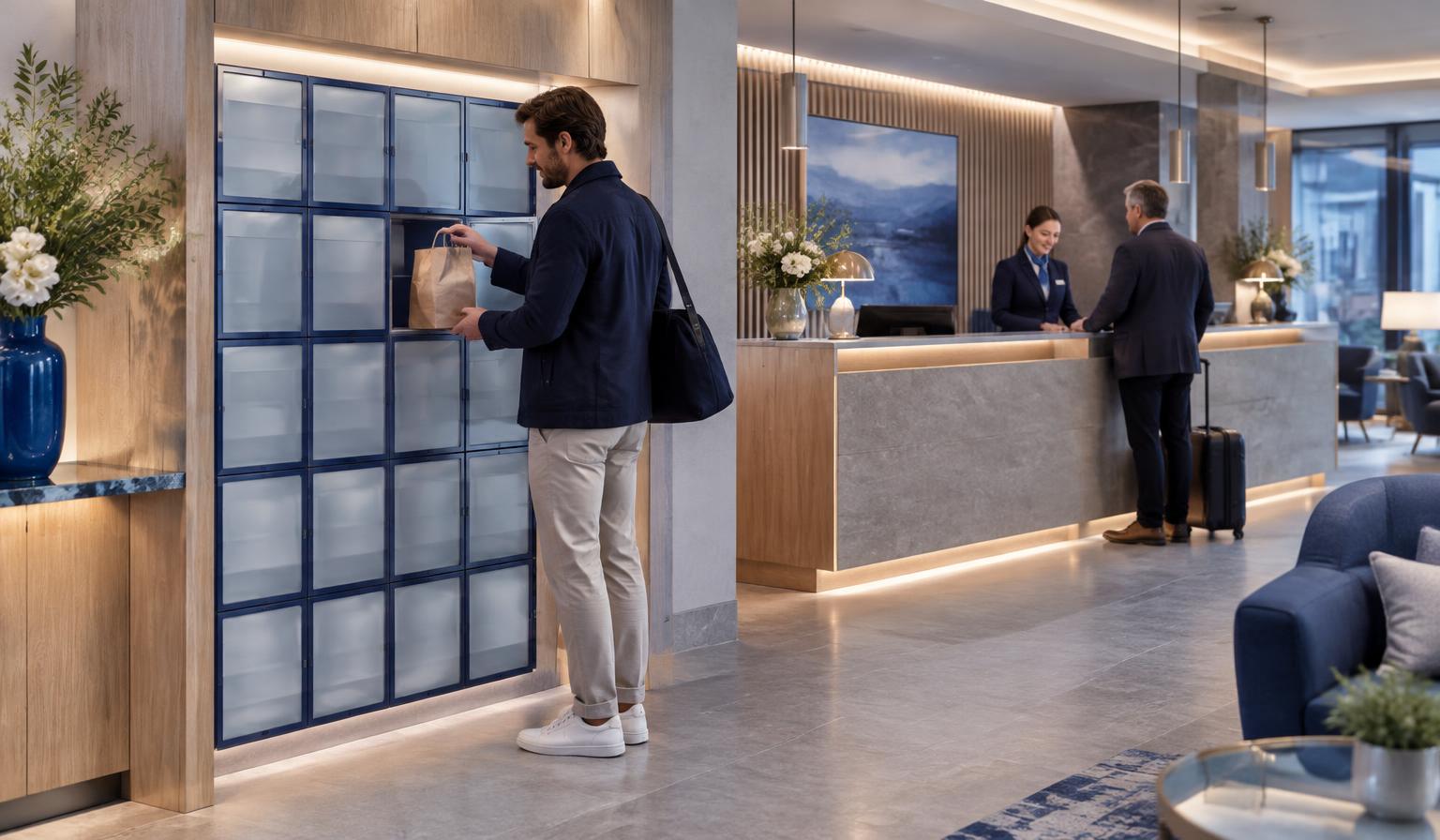
The most practical way to improve hotel food and beverage without adding a kitchen is to connect guests to food that already exists nearby. A curated local restaurant offer, guest-paid delivery and a secure Foodie Locker collection point can extend choice around the clock without overnight kitchen staff or front-desk handovers.
This is not a promise of free food. The guest pays the restaurant or delivery platform. The hotel chooses how to deploy the locker infrastructure — Fully Funded, Lease or Purchase — and whether to activate restaurant partnerships and other ancillary revenue opportunities.
What hotel guests actually need
Guests ask a simple question: can I order food delivery to my hotel? Hotel owners ask a related one: how can we improve the guest experience without increasing fixed operating costs? A good hotel F&B solution answers both. It gives guests clear 24/7 choice and gives the property one controlled handover point.
Make the policy easy to find before arrival and during the stay. Tell guests which delivery services and local partners they can use, where the order will be left, and how they will collect it. Clear information turns an improvised delivery into a dependable hotel amenity.
The low-overhead hotel F&B model
The model has three parts: welcome guest-paid delivery, curate a short list of reliable local restaurants, and give every courier one secure place to leave the order. Booking.com’s overview of room-service alternatives notes that traditional room service can be costly and operationally complex, while delivery platforms offer broader local choice. See the independent industry overview.
- Guest orders and pays through the restaurant or delivery platform
- Courier loads a secure insulated compartment in the lobby
- Guest receives a PIN or QR code and collects independently
- Reception avoids calls, bag storage, identity checks and handovers
- The hotel can promote trusted local partners and relevant add-ons
How this improves hotel guest experience
Food is often most important when the normal hotel offer is least available: after a late flight, before an early departure, between restaurant services or when a family needs something outside the standard menu. A delivery-friendly policy plus a secure collection point makes the answer clear before and during the stay.
The improvement is practical rather than theatrical: more choice, longer availability, less waiting at reception and no uncertainty about whether a courier is allowed inside. Hotels can make the service visible in pre-arrival messages, the guest directory, room QR cards and the booking-page amenities list.
How a hotel can create ancillary food and beverage revenue
Hotel ancillary revenue is income beyond the room charge. In this model, the hotel does not need to mark up every meal. It can create value through carefully agreed local restaurant partnerships, hotel add-ons offered at the right moment, and approved commercial activity on the Foodie Locker platform.
- Local restaurant placement or commission agreements
- Hotel bar, minibar, breakfast or snack add-ons linked to collection
- Curated dining packages for corporate, family or long-stay guests
- Commercial placements worth up to £200 per locker unit per month, depending on deployment and engagement
Treat revenue as an opportunity, not a guarantee. Track partner orders, guest usage, reception time recovered, food-related review comments and ancillary income against the hotel’s own baseline.
Fully Funded, Lease or Purchase
Foodie Locker offers three deployment routes. Qualifying properties can choose Fully Funded, covering hardware, software and ongoing support at £0 capex and £0 monthly fee through Foodie Locker’s commercial ecosystem. Selected properties may also participate in revenue share. Hotels can instead lease the system on a predictable monthly plan or purchase the hardware outright with a software licence.
The right option depends on property size, guest profile, delivery demand and how much commercial activity the hotel wants. Compare the current options on the Foodie Locker pricing page.
What to include in a hotel food-delivery policy
- State clearly that guests may order from approved food-delivery platforms and local partners
- Direct couriers to the Foodie Locker rather than guest floors
- Explain collection by PIN or QR code in pre-arrival and in-room information
- Define collection windows, cleaning checks and uncollected-order handling
- Keep restaurant allergen information and food preparation responsibility with the food provider
A clear policy turns delivery from an informal exception into a visible hotel amenity. For the detailed handover design, read the room-service alternatives guide.
A simple 90-day hotel pilot
Start with one property and a measurable baseline. Record delivery volume, reception interventions, late-night food questions, guest feedback and any partner income before launch. Then publish the delivery policy, onboard a small local restaurant group, install the locker and review the same measures after 30, 60 and 90 days.
The aim is not to replace a successful restaurant. It is to fill the gaps that restaurant hours, room service and vending cannot cover efficiently. See Foodie Locker for hotels or talk to the team about a property-specific plan.