
Food delivery operational efficiency: how to solve the food delivery dilemma in your building
Food deliveries drain reception time, compromise security and frustrate residents. How building operators cut handling costs and fix the food delivery dilemma for good.
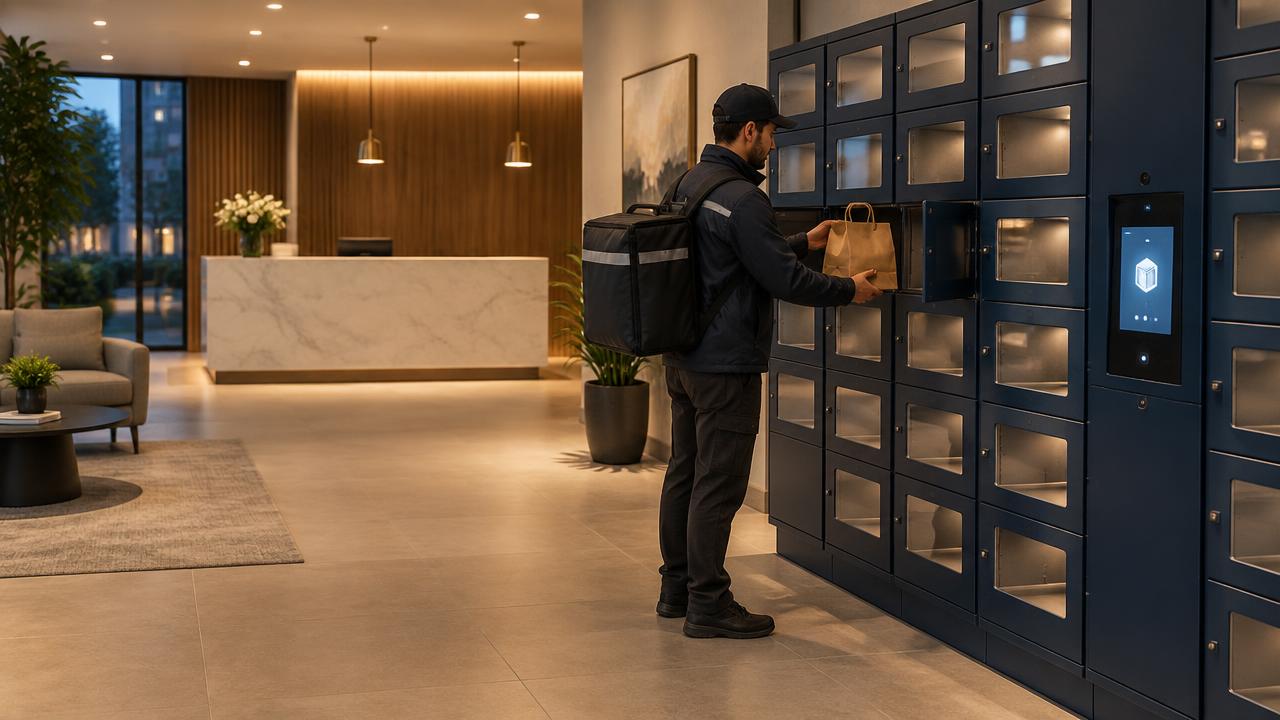
The food delivery dilemma is simple to describe: residents, students and employees order more takeaway, grocery and meal-kit deliveries every year, but buildings were never designed to receive them. The result is a daily operational problem that nobody budgeted for — staff time lost to handovers, couriers wandering corridors, cold or missing orders, and complaints landing at the front desk.
The quickest way to solve it is to stop handling food deliveries manually. A designated, self-service handover point — typically insulated smart food lockers at the building entrance — lets couriers drop orders in under a minute and lets recipients collect with a PIN or QR code, without staff involvement and without couriers entering the building.
What is the food delivery dilemma?
Most buildings face the same three-way trade-off. Let couriers in, and you compromise security and create liability. Make reception accept orders, and you divert paid staff into an unpaid logistics job. Make residents come down to meet every driver, and you damage the experience they are paying for — especially late at night.
None of those options scale. At one 840-bed student residence using Foodie Locker, 2,232 food deliveries arrived in a single month — around 72 a day. Every one of those is a handover someone has to manage.
The hidden operational cost of food deliveries
Food delivery rarely appears as a line item, which is why its cost is underestimated. Look for it in these places:
- Reception and concierge time: 2–5 minutes per handover for logging, storing, calling and chasing
- Peak-time bottlenecks: deliveries cluster between 6pm and 10pm, often when desks are thinly staffed or closed
- Security exposure: tailgating, propped doors and unescorted couriers in residential areas
- Storage and liability: perishable food held at a desk, disputes over missing or spoiled orders
- Complaints and churn: cold food, mix-ups and waiting in the lobby erode resident satisfaction and renewals
- Courier inefficiency: drivers circling sites looking for the right block adds traffic, emissions and delay
Multiply a few minutes per order by 50–100 orders a day and the result is often one or more full-time staff equivalents spent on food handovers. You can model your own numbers in the ROI calculator.
Five ways to improve food delivery operational efficiency
1. Create one designated delivery point. Give every courier a single, geocoded destination with clear signage and entrance photos, so they stop searching for flats or blocks.
2. Remove staff from the handover. Self-service lockers let couriers deposit and recipients collect independently, 24/7.
3. Keep couriers at the perimeter. Controlled drop-off at the entrance supports access policies and Building Safety Act duties without slowing deliveries.
4. Protect food quality. Insulated compartments keep orders fresher than a counter, floor or open-air doorstep during short dwell times.
5. Measure everything. Timestamped drop-off and collection data replaces anecdotes with evidence on volumes, peaks and collection times.
How smart food lockers solve the dilemma
A smart food locker turns an unmanaged flow into a managed process. The courier verifies the order on the touchscreen and places it in an assigned insulated compartment. The recipient is notified instantly and collects with a one-time PIN or QR code. Every drop-off and collection is logged.
At the 840-bed residence above, 66.7% of orders were collected within 20 minutes — with no reception involvement. For kitchens, rear-loading lockers let staff load from the back while customers and drivers collect from the front. See the Foodie Locker hardware spec.
Sector by sector: where the dilemma shows up
- Build-to-Rent and apartments: concierge teams absorbing evening delivery peaks and courier access risk
- Student accommodation (PBSA): high late-night volumes, safeguarding concerns and small reception teams
- Universities and campuses: couriers unable to locate halls and blocks across large estates
- Offices and workplaces: bulk lunch drops that someone must sort, distribute and chase
- Hotels: guests ordering takeaway instead of room service, with front desks acting as a delivery counter
- Restaurants and takeaways: counter queues and drivers waiting inside for collections
Explore the detail for Build-to-Rent, student accommodation, university campuses and workplace food delivery.
What does it cost to fix?
Less than most operators expect. Foodie Locker offers a fully funded model with £0 capital outlay and £0 monthly fee, where the building can also share in commercial revenue estimated at up to £200 per unit per month depending on site and usage. Supported and purchase options are also available. See pricing or the building owner overview.
A simple checklist for operators
- Count daily food, grocery and meal-kit deliveries and note peak hours
- Estimate staff minutes per handover and multiply by volume
- Log incidents: tailgating, missing orders, complaints
- Identify one lit, CCTV-covered location near the entrance for a delivery hub
- Decide your access policy: couriers stop at the perimeter
- Choose a funding model and set KPIs such as collection time and staff hours saved
Ready to see it in your building? Book a demo.