Could You Build a Business Around Food Lockers?
The operator model behind food locker services: identifying the customer need, finding locations and lining up the partners who deliver the service.
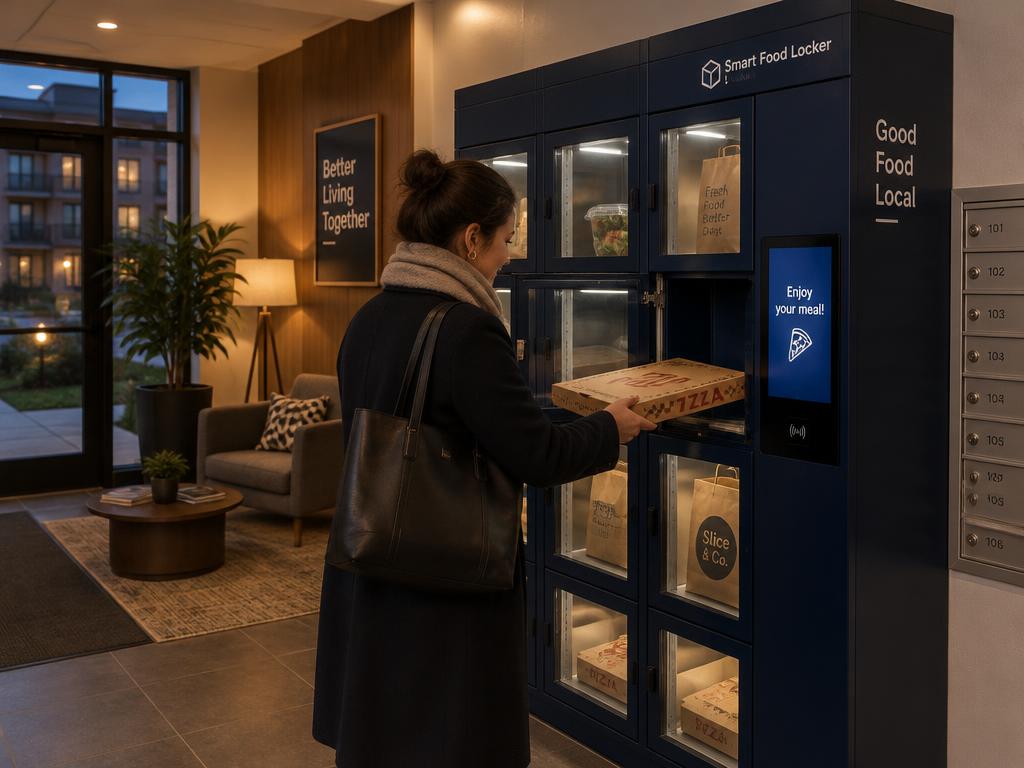
Every busy building has the same quiet problem: food deliveries arriving at all hours, couriers waiting at desks, and staff or concierges acting as unpaid parcel handlers. Wherever that problem exists, there is a potential business in solving it.
Food lockers are the kind of product you can build a service business around — but the businesses that work are built deliberately. This article walks through the three foundations: the customer need, the location, and the partners.
Start with the customer need, not the locker
The mistake is starting with the hardware and looking for somewhere to put it. The businesses that work start with a specific, painful need:
- A residential operator whose front desk spends hours a day managing food deliveries
- A university campus where late-night orders pile up in reception areas
- A restaurant or takeaway whose counter is crowded with waiting delivery drivers
- An office building where lunch orders arrive in a chaotic thirty-minute window
Each of these is a real, recurring cost — in staff time, in complaints, in lost orders. A locker is valuable precisely because it removes that cost. If you can point at the cost, you can make the case for the locker.
Find the right location
A locker earns its keep where deliveries are dense and collection is convenient. The strongest locations share a few traits: high delivery volume, a secure and accessible spot for the unit, and a clear reason for people to collect from it rather than anywhere else.
Residential buildings, student accommodation, offices, hotels and transport hubs all fit — but the best test is simple. Stand in the lobby at lunchtime or on a Friday evening. If you can see the problem, you have a location.
Line up the partners who deliver the service
No locker business runs on one person. The operator model depends on a small network of partners, each doing what they do best:
- The building or site owner, who provides the location and often the customer relationship
- The locker provider, who supplies the hardware, software and technical backup
- The food side — restaurants, delivery platforms or caterers whose orders flow through the unit
- Local support — installation, cleaning and first-line maintenance
The operator's job is to hold these together: to identify the need, secure the location, and coordinate the partners so the service runs smoothly day after day.
Where the revenue comes from
Locker businesses typically earn from more than one stream: the building pays for the amenity and the staff time it saves, and there can be additional income from services run through the locker — advertising, brand partnerships and delivery programmes. The mix depends on the site and the market.
If this sounds like a business you could build, the Foodie Locker partner programme is designed for exactly this model — and the licensing route suits partners who want to build it across a whole territory.