
Multi-tenant office buildings: solving the courier bottleneck across floors
One postcode, ten tenants, twenty floors, two thousand people — and a courier with thirty seconds and the wrong floor number. Here's how multi-tenant office buildings in London are turning the lobby into a self-serve courier hub instead of a security chokepoint.
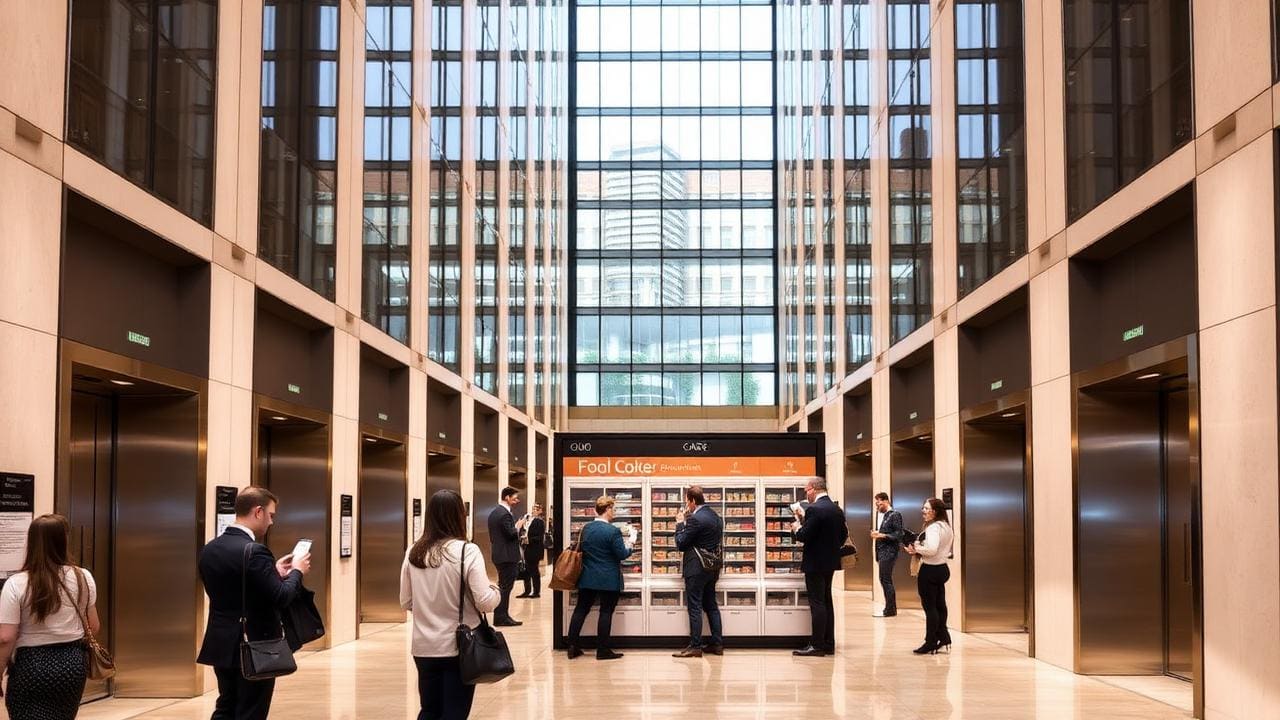
One postcode, ten tenants, twenty floors, two thousand people — and a courier with thirty seconds and the wrong floor number. Multi-tenant office buildings in central London now process more daily deliveries than mid-sized hotels, with none of the operational infrastructure to match. The fix is to stop treating the courier as a visitor and start treating the lobby as a self-serve hub.
Why multi-tenant buildings hit the bottleneck first
In a single-tenant office, reception is the company's own and can absorb delivery admin as part of facilities. In a multi-tenant building, reception works for the landlord, not the tenant — and is contractually thin on the delivery side. So the courier ends up bouncing between landlord reception, tenant reception, lift swipes and floor numbers, with the bag going cold in transit.
What the hub model looks like
A central bank of heated, chilled and ambient lockers in the ground-floor lobby, addressed to individuals across all tenants. Couriers scan and drop in 30 seconds, recipients PIN-collect when convenient. No tenant-by-tenant setup; no per-tenant locker bank; one shared infrastructure for the whole building.
Wayfinding and the single-postcode problem
Many London office complexes share one postcode across multiple cores. Couriers routinely land at the wrong core, walk the perimeter, and burn 10 minutes of delivery time. A geocoded locker address (and, where useful, a what3words pin) eliminates that. See the underlying argument in <a href="/blog/designated-drop-zone-multi-tenant-building-deliveries" className="text-primary underline underline-offset-2">Designated drop zones</a>.
Commercial model for multi-tenant
Three options. Landlord-funded as a building amenity (most common in premium specs and most credible at lease renewal). Tenant-contributed via service charge (works in mature shared services regimes). Hybrid — landlord funds the hardware, tenants contribute via amenity service charge. All three are workable; the right answer depends on the tenancy mix and the landlord's amenity strategy.
What changes for tenants
Lift swipes drop. Reception calls drop. Lost-order disputes drop. Food arrives hot. Tenants stop apologising to their staff about delivery friction. Leases renew. See also: <a href="/blog/office-reception-bottleneck-self-serve-delivery" className="text-primary underline underline-offset-2">reception bottleneck</a> and <a href="/blog/breeam-well-esg-office-amenity-lease-renewal" className="text-primary underline underline-offset-2">BREEAM, WELL and ESG</a>.
To scope a multi-tenant deployment for a specific building, <a href="/contact" className="text-primary underline underline-offset-2">book a demo</a>.